

-
CDST_LT: LT DST Introduction
-
CDST_LT: Requirements for submission, acceptance and processing of isolates for DST
FullscreenRequirements for submission, acceptance and processing for culture Isolates
Acceptance of MTB Isolates for DST
Preparing the Isolate for DST
Preparing the Isolate for Liquid Culture DST
Content1. Isolates can be grown on solid or liquid media before being tested in the MGIT DST.
-
Need healthy cells in the logarithmic phase of growth
-
Need fairly light inoculum so that drug concentrations are not overwhelmed
2. Growth should be AFB-positive and identified as a pure culture of the MTB complex before further testing.
Inoculum from the MGIT tube: It is important that the growth is within the following
-
The day an MGIT tube is positive by the instrument is considered Day 0.
-
The tube should be kept incubated for at least one more day (Day 1) before being
-
A positive tube may be used for drug susceptibility testing up to and including the fifth day (Day 5) after it becomes instrument positive. A tube that has been positive for more than 5 days should be subcultured in a fresh MGIT tube supplemented with MGIT 960 Growth Supplement and should be tested in an MGIT 960 instrument until it
-
If growth in a tube is on Day 1 or Day 2, mix well (vortex) to break up clumps.
-
If growth is on Day 3, 4, or 5, mix well to break up the clumps. Let the large
Resource
Mycobacteriology Laboratory Manual
Assessment
Question
Answer 1
Answer 2
Answer 3
Answer 4
Correct answer
Correct explanation
Page id
Part of Pre-test
Part of Post-te
The day an MGIT tube is positive by the instrument is considered as which day?
Day 0 Day 1 Day 2 Day 3 The day an MGIT tube is positive by the instrument is considered Day 0. -
-
CDST_LT: SIRE susceptibility testing
FullscreenSIRE Susceptibility Testing
ContentThe BACTEC MGIT 960 susceptibility testing for Streptomycin (S), Isoniazid (I), Rifampin (R) and Ethambutol (E), called SIRE, is a rapid and qualitative method that uses critical test concentrations of the four drugs.
Components of SIRE Kit
The kit has one vial for each of the drugs (S, I, R and E) and 8 vials of the MGIT 960 SIRE Supplement.
Drugs:
Drug
Approximate lyophilized drug per vial
Streptomycin (S)
332 µg
Isoniazid (I)
33.2 µg
Rifampin (R)
332µg
Ethambutol (E)
1660µg
SIRE Supplement: It differs from the MGIT Growth Supplement and contains the following:
Bovine Albumin
50g/l
Dextrose
20g/l
Catalase
0.03g/l
Oleic Acid
0.6g/l
Resource
Mycobacteriology Laboratory Manual
Assessment
Question
Answer 1
Answer 2
Answer 3
Answer 4
Correct answer
Correct explanation
Page id
Part of Pre-test
Part of Post-te
Which of the following is NOT a component of the SIRE kit? Streptomycin (S) Isoniazid (I) Rifabutin (R) Ethambutol (E) Answer 4 Components of the SIRE Kit are Streptomycin (S), Isoniazid (I), Rifampin (R), and Ethambutol (E). Critical Concentrations and Reconstitution of SIRE Drugs
ContentBACTEC MGIT 960 SIRE Kit for critical concentrations contains the following drugs in
Drugs
Streptomycin - approximate lyophilized drug per vial --------------- 332µg
INH - approximate drug per vial ---------------------------------------- 33.2 µg
Rifampin – approximate drug per vial ---------------------------------- 332 µg
Ethambutol – approximate drug per vial -------------------------------1660 µg
SIRE supplement
The SIRE supplement vial differs from the MGIT Growth Supplement and contains, per litre
Bovine albumin -------------------- 50.0 g
Dextrose----------------------------- 20.0 g
Catalase ----------------------------- 0.03 g
Oleic acid ---------------------------- 0.6 g
Storage
Upon receipt, refrigerate the lyophilized drugs at 2-8ºC. Reconstitute prior to use. Once
Reconstitution of SIRE Drug Lyophilized Drugs (stock preparation)
Reconstitute the drugs with the appropriate volume of diluent as described below. Volumes vary with different drugs. Failure to use the appropriate volume will invalidate these tests.
Preparation of drugs in MGIT 960 SIRE Kit
1 Reconstitute each Streptomycin lyophilized drug vial with 4 ml of sterile distilled/ deionized water to make a stock solution of 83μg/ml.
2 Reconstitute each Isoniazid lyophilized drug vial with 4 ml of sterile distilled/ deionized water to make a stock solution of 8.3μg/ml.
3 Reconstitute each Rifampicin lyophilized drug vial with 4 ml of sterile distilled/ deionized water to make a stock solution of 83μg/ml.
4 Reconstitute each Ethambutol lyophilized drug vial with 4 ml of sterile distilled/ deionized water to make a stock solution of 415μg/ml.
Resource
Mycobacteriology Laboratory Manual
Assessment
Question
Answer 1
Answer 2
Answer 3
Answer 4
Correct answer
Correct explanation
Page id
Part of Pre-test
Part of Post-te
The opened and reconstituted drug solutions can be stored under which conditions? Stored at -20ºC or Stored at -20ºC or Stored at -20ºC or Stored at -20ºC or 3 Once
-
CDST_LT: Pyrazinamide (PZA) susceptibility testing
FullscreenPyrazinamide PZA Susceptibility Testing
ContentThe BACTEC MGIT 960 PZA medium tube contains 7 ml of broth. It consists of 5.9 g of
The BACTEC MGIT PZA Drug Kit contains two vials of 20,000 µg of lyophilized PZA and
Bovine albumin---------------------------50.0 g
Dextrose -----------------------------------20.0 g
Polyoxyethyline state (POES) -----------1.1 g
Catalase -------------------------------------0.03 g
Olecic acid --------------------------------- 0.1 g
Storage instructions: PZA medium may be stored at 2-25ºC. Do not freeze, avoid exposure
Upon receipt, PZA drug vials should be stored at 2-8ºC. Once reconstituted, the antibiotic
Resource
Mycobacteriology Laboratory Manual
Assessment
Question
Answer 1
Answer 2
Answer 3
Answer 4
Correct answer
Correct explanation
Page id
Part of Pre-test
Part of Post-te
PZA supplement contains which of the following? Bovine albumin Dextrose Polyoxyethylene state (POES) All of the above Answer 4 PZA supplement contains Bovine albumin, Critical Concentration and Reconstitution of PZA
ContentCritical Concentration for PZA Drugs Recommended for the Treatment of DS- TB
Anti TB drugs
CC (ug/ml) for DST medium
Pyrazinamide
100μg/mL
Reconstitution of PZA Lyophilized Drugs (Drug stock preparation)
Reconstitute the PZA drug vial with 2.5 ml sterile distilled/ deionized water to make a stock solution of 8000 μg/ml. Failure to use the appropriate volume will invalidate these tests.
Drug lyophilised
Volume
added
Concentration of
reconstituted agent
μg/mL
Volume added
to each MGIT tube
Final concentration
in MGIT tubes
Pyrazinamide
2.5ml
8000 μg/ml
100
100μg/mL
Resource
Mycobacteriology Laboratory Manual
Assessment
Question
Answer 1
Answer 2
Answer 3
Answer 4
Correct answer
Correct explanation
Page id
Part of Pre-test
Part of Post-te
Which of the following is the Critical Concentration for PZA drugs recommended for the treatment of DS- TB?
100μg/mL 10μg/mL 1000μg/mL 800μg/mL Answer 1 Critical Concentration for PZA drugs recommended for the treatment of DS- TB is:100μg/mL.
-
CDST_LT: Second line drug testing
FullscreenSecond-line Phenotypic Drug Susceptibility Testing
ContentMultidrug-resistant (MDR) TB is caused by strains of MTB resistant to at least isoniazid and rifampicin; for effective MDR patient management, optimized treatment regimens are required. These complex regimens can include a fluoroquinolone, aminoglycoside, cyclic peptide or compounds from other drug classes, and any remaining first-line susceptible drugs.
Therefore, reliable drug susceptibility testing (DST) of these anti-TB drugs is crucial for the management of MDR-TB and for preventing the emergence of additional drug resistance in these patients.
Isolated cultures from TB patients are subjected to growth in the presence of a known concentration of a test drug. Growth control is also included without the addition of the drug. If the patient’s isolate grows in control but does not grow in the presence of the drug, it is considered susceptible. On the other hand, if it grows in both tubes, then it is considered to be resistant to that drug. Many methods are in use for susceptibility testing. The most commonly used method is the proportion method, where resistance is established at the 1% cut-off point for all the drugs. This means that if 1% or more of the total bacterial population is resistant to a drug, the strain is designated to be resistant to that drug.
Resource
Mycobacteriology Laboratory Manual
Assessment
Question
Answer 1
Answer 2
Answer 3
Answer 4
Correct answer
Correct explanation
Page id
Part of Pre-test
Part of Post-te
In the proportion method, resistance is established at which of the following cut-off points? At 1% cut-off point for all the drugs Is established by MIC Both MIC and 1% cut-off point for all drugs At a 1% cut-off point for some of the drugs Answer 1 The most commonly used method is the proportion method, where resistance is established at the 1% cut-off point for all the drugs. This means that if 1% or more of the total bacterial population is resistant to a drug, the strain is designated to be resistant to that drug. Critical Concentration and formulations of Second-line Anti-TB Drugs for DST
ContentPreparation of second-line drug stock:
Drug preparation: Prepare the drug concentration as per national and/or internationally defined drugs critical concentration, solvent and diluents of second-line drugs for DST by MGIT.
Drugs
Critical concentrations (μg/ml)
Solvent
Diluent
Kanamycin
2.5
DW
DW
Amikacin
1.0
DW
DW
Capreomycin
2.5
DW
DW
Ofloxacin
2.0
NaOH
DW
Levofloxacin
1.5
NaOH
DW
Moxifloxacin
0.5 /1.0
1N NaOH
DW
Linezolid
1.0
DMSO
DW
Clofazimine
1.0
DMSO
DMSO
PAS
4.0
Ethanol
DW
Ethionamide
5.0
DMSO
DW
All antimicrobial agents are assayed for standard units of activity. The assay units may differ widely from the actual weight of the powder and often may differ between drug production lots. Thus, the lab must standardize the antimicrobial solutions based on the potency of an individual lot of each drug powder.
The following formula is used to calculate the actual weight of the drugs to be weighed:
Volume (mL) x Concentration (mg/mL) x dilution factor
Weight (mg) = ------------------------------------------------------------------
Assay potency (mg/mg)
-
Weight (milligrams) is the weight of powder needed to prepare the desired volume of stock solution at the desired concentration.
-
Volume (in millilitres) is the desired volume of stock solution
-
Assay potency (micrograms per milligram) is the activity or potency specified by the manufacturer of the reference standard powder. This value usually appears on the label or the certificate of analysis.
-
Concentration (micrograms per millilitre) is the desired concentration (critical concentration) of stock solution.
-
The dilution factor is the number of times the drug added to the tube (100ml) is getting diluted by the total volume of the medium in the tube (8.3ml) = 83
Stock solutions of each drug are to be made 83 times higher for MGIT. Prepare a stock solution with a higher concentration than the highest concentration required in the medium. The dilution factor for MGIT is 1:83 (7mL of MGIT media + 0.8 mL of DST supplement + 0.5 mL of test inoculum /culture).
Example: Amikacin
Concentration to be tested: 1 µg/ml
Volume of the stock solution: 20 ml
Potency of the drug: (e.g.) 716 µg /mg
Dilution factor: 83
Diluent: Sterile distilled water (DW)
Amount of drug to be weighed to prepare 20 ml of stock solution:
20 x 1 x 83
----------------- = 2.32 mg
716
NOTE:
1. As it is difficult to weigh 2.32 mg (0.00232 grams), weigh 100 times this weight, i.e. 232 mg, and dissolve in 20 ml of sterile DW, aliquot in 500µl volume and store at – 20/ -70 oC.
2. At the time of setting up DST, prepare a working stock by diluting the stock 100 times, i.e. 100 µl of stock + 9.9 ml sterile DW, and add 100µl of this working solution to the designated MGIT tube.
3. As the assay potency is likely to vary with varying batches, care must be taken to include the correct potency factor while preparing the stock solution.
Resource
Mycobacteriology Laboratory Manual
Assessment
Question
Answer 1
Answer 2
Answer 3
Answer 4
Correct answer
Correct explanation
Page id
Part of Pre-test
Part of Post-te
Which of these solvents is NOT used for drug preparation? NaOH DMSO Ethanol PAS Answer 4 PAS is a drug and not a solvent. The solvents used for drug preparation are NaOH, DMSO, and Ethanol. -
Preparation and Storage of Second-line Anti-TB Drugs used for DST
ContentPreparation and Storage of Second-line Anti-TB Drugs used for DST
-
Freeze the stock solutions preferably at -20ºC or lower in appropriate tubes and use for up to 6 months or up to the date of original expiry, whichever comes sooner.
-
At the time of testing, make 100 folds dilution (1:100) to achieve the desired concentration and store at -20ºC or lower in appropriate tubes and use for up to 6 months or up to the date of original expiry, whichever comes sooner.
-
Once the working solution drug is thawed, use it immediately and do not re-freeze. Discard unused portions.
-
Always pipette accurately 100uL of the drug to the designated drug labelled MGIT tube.
Important notes for preparation of drug solutions
1. All the drugs, except Ethionamide, should be filter sterilized. Use a 0.2-micron syringe filter for sterilization of the drugs. Discard the first 20% filtered solutions, and collect the remaining solution for use.
2 In the case of self-sterilizing solutions as well as other aqueous stock solutions, all further dilutions should be made in water, using sterile distilled water and aseptic techniques.
3 If a solvent other than water is recommended, only use sufficient solvent to solubilize the antimicrobial powder and then dilute to the final stock concentration with sterile distilled water.
4 Record batch no., date of preparation and expiry date for all drugs. Store the stock solutions in small aliquots at –20° C / 70° C. Once thawed and used, discard the remainder. Refreezing may affect the potency of the drugs.
Resource
Mycobacteriology Laboratory Manual
Assessment
Question
Answer 1
Answer 2
Answer 3
Answer 4
Correct answer
Correct explanation
Page id
Part of Pre-test
Part of Post-te
Stock solutions are kept at which of these temperatures? Room temperature -20ºC 4ºC 20ºC -20ºC Stock solutions are preferably stored at -20ºC or lower. Yes Yes -
-
CDST_LT: Inoculum preparation and incubation for MGIT DST
FullscreenInoculum Preparation for First and Second-line Phenotypic DST
Content-
Label the required number of 7 mL MGIT tubes with lab ID. In addition, label tubes with one of each of the following: GC (Growth Control), drug 1, drug 2 etc.
-
Place the tubes in the suitable AST set carrier (5 tubes or 8 tubes), from left to right: GC, drug 1, drug 2 etc. (as per the number of drugs to be tested).
-
Aseptically add 800 μl of BACTEC MGIT OADC Supplement to each MGIT tube. Do not use MGIT 960 growth supplement or PZA supplement.
-
4 Aseptically pipette 100 μl of the reconstituted drug into the corresponding labelled MGIT tube; e.g., add 100 μl AMK (amikacin) solution to the MGIT tube labelled as “AMK”, etc.
-
It is important to add the correct drug to the corresponding tube.
-
Do not add drugs to the MGIT GC tube.
Resource
Mycobacteriology Laboratory Manual
Assessment
Question
Answer 1
Answer 2
Answer 3
Answer 4
Correct answer
Correct explanation
Page id
Part of Pre-test
Part of Post-te
MGIT GC Tube has which of the following? Dilute test culture suspension Undiluted test culture suspension Culture with drugs Culture without drugs Answer 1 MGIT GC Tube has Diluted the test culture suspension -
Inoculum Preparation from MGIT Positive Culture
ContentInoculation Preparation for Drug-containing Tube (1-2 days)
-
DST must not be set up on the same day an MGIT tube signals positive (0 Day).
-
If the culture is worked up one or two days after signalling positive, it can be used directly to inoculate the MGIT tubes for DST.
-
Mix well (vortex) the confirmed MTB pure culture isolate to break up the clumps. Leave the tube undisturbed for about 5-10 minutes to let big clumps settle on the bottom.
-
Use the undiluted supernatant for inoculation of the drug tube set.
-
Aseptically add 0.5 ml of the well-mixed culture suspension (inoculum) into each drug-containing tube using a pipette. Do not add to the growth control (GC).
Inoculation Preparation for Growth Control (GC) Tube (1-2 days)
For the growth control (GC) tube, first, dilute the test culture suspension 1:100 by adding 0.1 ml of the test culture suspension to 10.0 ml of sterile saline. Mix well by inverting the tube 5-6 times. Use this diluted suspension to add 0.5 ml into the growth control tube.
Inoculation Preparation for Drug-containing Tube (3-5 days)
-
If the culture is used to set up DST between three and five days after signalling positive.
-
Mix well (vortex) the confirmed MTB pure culture isolates to break up the clumps. Leave the tube undisturbed for about 5-10 minutes to let big clumps settle on the bottom.
-
Use the undiluted supernatant for preparation of 1:5 dilution, 1 ml of MGIT broth in 4 ml of sterile saline (1:5 dilution).
-
Use this well-mixed diluted culture for inoculation of the drug tube set.
-
Aseptically add 0.5 ml of the well-mixed culture suspension (inoculum) into each drug-containing tube using a pipette. Do not add to the growth control (GC).
Inoculation Preparation for Growth Control (GC) Tube (3-5 days)
-
For the growth control (GC) tube, first, dilute the test culture suspension 1:100 from 1:5 diluted MGIT tube. by adding 0.1 ml of the test culture suspension to 10.0 ml of sterile saline. Mix well by inverting the tube 5-6 times. Use this diluted suspension to add 0.5 ml into the growth control tube.
-
A tube that has been positive for more than 5 days should not be subjected to DST. Instead, it should be subcultured in a fresh MGIT tube supplemented with MGIT 960 Growth Supplement and should be tested in an MGIT 960 instrument until it is positive.
3 Use this tube from one to five days of instrument positivity as described above.
Resource
Mycobacteriology Laboratory Manual
Assessment
Question
Answer 1
Answer 2
Answer 3
Answer 4
Correct answer
Correct explanation
Page id
Part of Pre-test
Part of Post-te
DST must not be set up on the same day an MGIT tube signals positive (0 Day). True False True DST must not be set up on the same day an MGIT tube signals positive (0 Day). -
Inoculation of Growth Control Tube/Drug Containing Tubes
ContentIt is extremely important to perform quality control of drug susceptibility testing
It is not necessary to include a resistant strain, as most of the resistant strains against a drug which are available from ATCC and other culture collections are highly resistant and do not give any added benefit in quality control. The test procedure for QC organisms is the same as described above for clinical isolates. The inoculum should be from a freshly grown culture in the
Resource
Mycobacteriology Laboratory Manual
Assessment
Question
Answer 1
Answer 2
Answer 3
Answer 4
Correct answer
Correct explanation
Page id
Part of Pre-test
Part of Post-te
Which QC Strain is used in MGIT DST? M. tuberculosis H37Rv M.kansasii M.fortuitum M.avium Answer 1 M. tuberculosis H37Rv (ATCC [American Type Culture Collection] number
27294) as a QC strain which is susceptible to all anti-tuberculosis drugs.
PZA Inoculum Preparation
ContentThe PZA susceptibility test is recommended for a pure culture of the M. tuberculosis complex.
Preparation from a positive MGIT tube:
Use a freshly positive MGIT tube.
-
Day 0 – the day an MGIT tube is positive by the instrument. Re-incubate.
-
Day 1 or 2 – one or two days after instrument positive. Use undiluted for the susceptibility
-
Day 3, 4 or 5 – mix well and dilute 1:5 by adding 1.0 ml of positive broth in 4.0 ml of sterile
-
Day 6 and onward – subculture in a fresh MGIT tube and follow the above guidelines.
Caution: Avoid mycobacterial clumps by mixing the growth well (vortex) and letting it stand
Preparation from growth on a solid medium:
-
Scrape off as many colonies as possible from the surface of the solid medium using a sterile loop or wooden applicator stick.
-
Transfer into a sterilized tube containing 4-5 ml of sterile 7H9 broth with 8-10 glass beads. Tighten the screw cap and vortex the broth for 1-2 minutes.
-
Leave the culture suspension undisturbed for 20 minutes. Then, carefully remove the supernatant fluid and transfer it to a fresh sterile tube.
-
Vortex again and leave undisturbed for 15 minutes. Then, transfer the supernatant fluid into a third sterile tube.
-
Adjust the turbidity of the suspension to McFarland #0.5 standard by gradually adding sterile saline.
-
For susceptibility test inoculation, dilute this suspension 1:5 by adding 1.0 ml of the
Resource
Mycobacteriology Laboratory Manual
Assessment
Question
Answer 1
Answer 2
Answer 3
Answer 4
Correct answer
Correct explanation
Page id
Part of Pre-test
Part of Post-te
The PZA susceptibility test is recommended for which of the following? Pure Culture of M. tuberculosis complex Mixed Culture of M. tuberculosis complex 7 days old culture 5 days old culture Answer 1 The PZA susceptibility test is recommended for a pure culture of the M. tuberculosis complex. -
Inoculation of PZA Growth Control/Drug Containing Tube
ContentInoculation of PZA Growth Control/Drug-containing Tube
-
Label two MGIT PZA tubes, one as GC (growth control) and one as PZA (drug-containing). Using a pipette, aseptically add 0.8 ml of PZA supplement to each of
-
Aseptically add 0.1 ml (100 µL) of the reconstituted drug into the PZA tube. If
-
Inoculate 0.5 ml of the culture suspension to the PZA tube using a sterile pipette.
-
For growth control inoculation, first, dilute the inoculum 1:10 by adding 0.5 ml of
Note: For the PZA susceptibility test, the inoculum for the control is diluted 1:10 and not
-
Tighten the caps and gently invert both MGIT tubes several times to mix. Place them in two AST Set Carriers with the sequence of the first GC and the PZA.
-
Enter the PZA set into the instrument using AST set entry feature.
-
Check the purity of the inoculum by streaking a loopful of the culture suspension
Precautions: All the additions and handling of cultures should be done only inside a
Dilution (1:10) of the culture suspension for growth control and mixing is critical.
Resource
Mycobacteriology Laboratory Manual
Assessment
Question
Answer 1
Answer 2
Answer 3
Answer 4
Correct answer
Correct explanation
Page id
Part of Pre-test
Part of Post-te
Select the MGIT PZA DST correct sequence in the set carrier.
GC > PZA PZA Alone GC Alone PZA > GC Answer 1 The correct sequence in the set carrier is GC, followed by PZA.
Yes Yes -
Incubation of MGIT 960 DST Sets
ContentIncubation of MGIT DST tubes
-
Tighten the caps and mix the inoculated broth well by gently inverting the tube
-
Susceptibility test "Set Carriers" are provided in different numbers of drug
five tubes is used. Place labelled tubes in the correct sequence in the set carrier (GC, STR, INH, RIF, EMB).
-
Enter the susceptibility set carrier into the BACTEC MGIT 960 instrument using the susceptibility test set entry feature. Ensure that the order of the tubes in the AST Set Carrier conforms to Set Carrier definitions. For example, GC, STR, INH, RIF, and EMB for the SIRE
-
To check the inoculum's purity, streak the test culture suspension
Resource
Mycobacteriology Laboratory Manual
Question
Answer 1
Answer 2
Answer 3
Answer 4
Correct answer
Correct explanation
Page id
Part of Pre-test
Part of Post-te
Select the MGIT DST correct sequence in the set carrier.
GC > STR > INH > RIF > EMB STR > INH > RIF > EMB Drug tube only STR > INH > RIF > EMB > GC Answer 1 The correct sequence in the set carrier is GC > STR > INH > RIF > EMB.
Yes Yes -
-
CDST_LT: Reading and reporting of MGIT 960 DST results
FullscreenPrinciple of MGIT DST Reading
ContentPrinciple of MGIT DST Reading:
Two Mycobacterial Growth Indicator Tubes (MGITs) are inoculated with the test culture. Then, a known concentration of a test drug is added to one of the MGIT tubes (drug-containing tube), and growth is compared with the MGIT tube without the drug (growth control).
If the test drug is active against the isolated mycobacteria, it will inhibit the growth, and thus there will be suppression of fluorescence, while the growth control will grow uninhibited and will have increasing fluorescence.
The BACTEC MGIT 960 instrument continually monitors all tubes for increased fluorescence. Analysis of fluorescence in the drug-containing tubes compared to the fluorescence in the Growth Control tube is used to determine susceptibility results.
When the growth unit (GU) of the growth control reaches 400 within 4-13 days (SIRE) or 4-21 days (PZA), the GU values of the drug-containing vials are evaluated.
• S = Susceptible = the GU of the drug tube is less than 100
• R = Resistant = the GU of the drug tube is 100 or more
Resources
Assessment
Answer 1
Answer 2
Answer 3 Answer 4 Correct answer
Correct explanation
Page id
Part of Pre-test
Part of Post-test
Drug-containing vials are evaluated when the growth unit (GU) of the growth control reaches 400.
True
False
1
When the growth unit (GU) of the growth control reaches 400 within 4-13 days (SIRE) or 4-21 days (PZA), the GU values of the drug-containing vials are evaluated.
YES
YES
Procedure for Reading MGIT DST Results
ContentProcedure for Reading MGIT DST Results
Once the Antimicrobial Susceptibility Testing (AST) sets are loaded/entered, the BACTEC MGIT 960 instrument continually monitors all tubes for increased fluorescence. When the growth unit (GU) of the Growth Control (GC) tube reaches ≥400 within the timed protocol, the instrument marks the DST as complete and interprets the results. GU values of the drug-containing vials are evaluated, and final results are reported as Susceptible or Resistant as follows:
-
S = Susceptible = the GU of the drug tube is less than 100
-
R = Resistant = the GU of the drug tube is 100 or more
The steps involved in reading the MGIT DST results are listed below:
-
Completed AST sets (indicated by a red “+” on the drawer) are removed from the respective drawers, and an “Unloaded AST Set” report is printed.
-
All the unloaded AST sets are matched with the printed report and any discrepancies observed are resolved.
-
Before reporting, all ‘resistant’ tubes are observed visually for evidence of contamination. ZN stain is performed on any suspicious tube and subculture to a Blood Agar or Brain Heart Infusion agar Plate. Additionally, when drug resistance is observed and the patient’s isolate was not previously resistant to the drug, tube(s) are tested with ZN and Blood Agar or Brain Heart Infusion Agar Plate to ensure that growth is not due to contaminants or MOTT.
-
DST reports are recorded as “Susceptible” or “Resistant” on the internal lab worksheet/book and the laboratory register.
Resources
Assessment
Question
Answer 1
Answer 2
Answer 3
Answer 4
Correct answer
Correct explanation
Page id
Part of Pre-test
Part of Post-test
The MGIT instrument marks the DST as complete and interprets the results when the GU in the Growth control tube reaches ________.
≥100
≥400
≥200
≥1000
2
When the growth unit (GU) of the Growth Control (GC) tube reaches ≥400 within the timed protocol, the instrument marks the DST as complete and interprets the results.
YES
YES
-
Unloaded MGIT DST Report
ContentUnloaded MGIT DST Report
A completed DST in the Bactec MGIT-960 instrument is indicated by a red “+” on the drawer. The following steps are involved in removing the completed DSTs from the instrument and printing the “Unload AST Set” report:
Step 1: Open the desired drawer. Press the “Remove Completed AST Sets”
soft key. Step 2: The first completed AST set stations illuminate with FLASHING GREEN indicators.
Step 3: Remove the carrier, starting with the completed set closest to the front of the drawer, and scan its barcode label. The LEDs at this station extinguish.
Step 4: Repeat steps 2 – 3 to remove additional AST sets.
Step 5: Place completed AST sets in the AST tube rack.
Step 6: Close the drawer and press the “printer” soft key to access the report selection.
Step 7: Press the “Unloaded AST set report” soft key to print the report.
“Unloaded AST set report” soft key to print the report. Note: Ensure that a working printer is connected to the instrument and check that the paper is present before printing the report.
Resource
Mycobacteriology Laboratory Manual, First Edition, April 2014, Global Laboratory Initiative
Assessment
Question
Answer 1
Answer 2
Answer 3 Answer 4 Correct answer
Correct explanation
Page id
Part of Pre-test
Part of Post-test
A completed DST in the Bactec MGIT-960 instrument is indicated by a red “+” on the drawer.
True
False
1
A completed DST in the Bactec MGIT-960 instrument is indicated by a red “+” on the drawer.
YES
YES
Validation of Resistant/Unexpected MGIT DST Results
ContentValidation of Resistant/Unexpected MGIT DST Results
1. Validation of Resistant MGIT DST Results
Observe all ‘resistant’ tubes visually for evidence of contamination when first removed from the instrument. Then, perform a ZN stain on any suspicious tube and subculture to a Blood agar plate (BAP) or Brain Heart infusion (BHI) agar plate to rule out the contamination.
In addition, when drug resistance is observed, and the patient’s isolate has not been tested before, or if the isolate was not previously resistant to the drug, test the tube(s) with ZN and BAP/BHI to ensure that growth is not due to contaminants or Mycobacteria Other Than Tuberculosis (MOTT).
2. Validation of Unexpected MGIT DST Results
If DST results for any drug are inconsistent with previous results for the same patient, review the results and QC and repeat the test. If the repeat result is discrepant with the first result, repeat the test a third time and record the third test result as the tiebreaker.
Resources
Assessment
Question
Answer 1
Answer 2
Answer 3 Answer 4 Correct answer
Correct explanation
Page id
Part of Pre-test
Part of Post-test
Validation of the results is required if DST results for any drug are inconsistent with previous results for the same patient.
True
False
1
If DST results for any drug are inconsistent with previous results for the same patient, review the results and QC and repeat the test.
YES
YES
If DST results for any drug are inconsistent with previous results for the same patient, review the results and report. True False 2 If DST results for any drug are inconsistent with previous results for the same patient, review the results and QC and repeat the test. If the repeat result is discrepant with the first result, repeat the test a third time and record the third test result as the tiebreaker. YES YES LC DST Recording and Reporting
ContentLC DST Recording and Reporting
LC DST Recording
Once the LC DST results are validated, they should be recorded in the standard ‘NTEP Laboratory Register for Culture, CBNAAT and Drug Susceptibility Testing (Annexure IV)’. The result of the DST for a particular drug is recorded as either S (Sensitive) or R (Resistant) in the box provided for that drug.
A copy of Annexure IV is given below:
Image
LC DST Reporting
NTEP guidelines mandate the reporting of DST results to the requesting district/physician through Ni-kshay within the stipulated turn-around time. Resources:
Guidelines for programmatic Management of Drug-resistant Tuberculosis in India, 2021
Assessment
Question
Answer 1
Answer 2
Answer 3
Answer 4
Correct answer
Correct explanation
Page id
Part of Pre-test
Part of Post-test
The C&DST laboratory records the results of LC-DST in which of the following Annexures?
Annexure I
Annexure II
Annexure V
Annexure IV
4
Once the LC DST results are validated, they should be recorded in the standard ‘NTEP Laboratory Register for Culture, CBNAAT and Drug Susceptibility Testing (Annexure IV)’.
YES
YES
Tuberculosis Laboratory Register
ContentThe Tuberculosis (TB) Laboratory Register is a paper-based recording register kept in all National TB Elimination Programme (NTEP) laboratories for recording details of diagnostic services offered to TB patients referred from both private and public health facilities.
The register is maintained in the Designated Microscopy Centre (DMC). It is the only register used for recording the details of specimen smear examinations. The Laboratory Technician (LT) is responsible for maintaining and updating the laboratory register.
There are two portions in the TB lab register and the table below shows the details captured in each portion.
Table: Pages and Information Covered in the TB Laboratory Register; Source: NTEP Training Module 2 for Programme Managers & Medical Officers
PORTION
DETAILS CONTAINED
Left-hand Portion
Lab serial number assigned by the LT
Date of the sample collection
Patient details such as name, sex, age, address, and contact number
Information on if the patient is from a key population
Referring health facility details
Reasons for examination
Right-hand Portion
Details on the type of specimen
Visual appearance results along with dates
Comorbidity status (HIV and Diabetes)
Details of drug susceptibility testing
Nikshay ID / Notification
Treatment initiation details
The last two columns are for the LT’s signature and remarks by the LT or supervisor
Important Points to Note
- Duplicate registers should not be maintained.
- LTs should ensure that the correct laboratory serial number is recorded.
- Laboratory serial number is given to the patient and not to the sample. A new number should be assigned to every presumptive TB case whose sputum is to be examined.
- All smear-positive (including scanty) results should be recorded in red ink.
- No over writing or manipulation in already entered data should be done.
The figure below shows the left-hand portion of the TB lab register. Click here to access the full form in the NTEP Training Module 2 for Programme Managers & Medical Officers, p. 219.
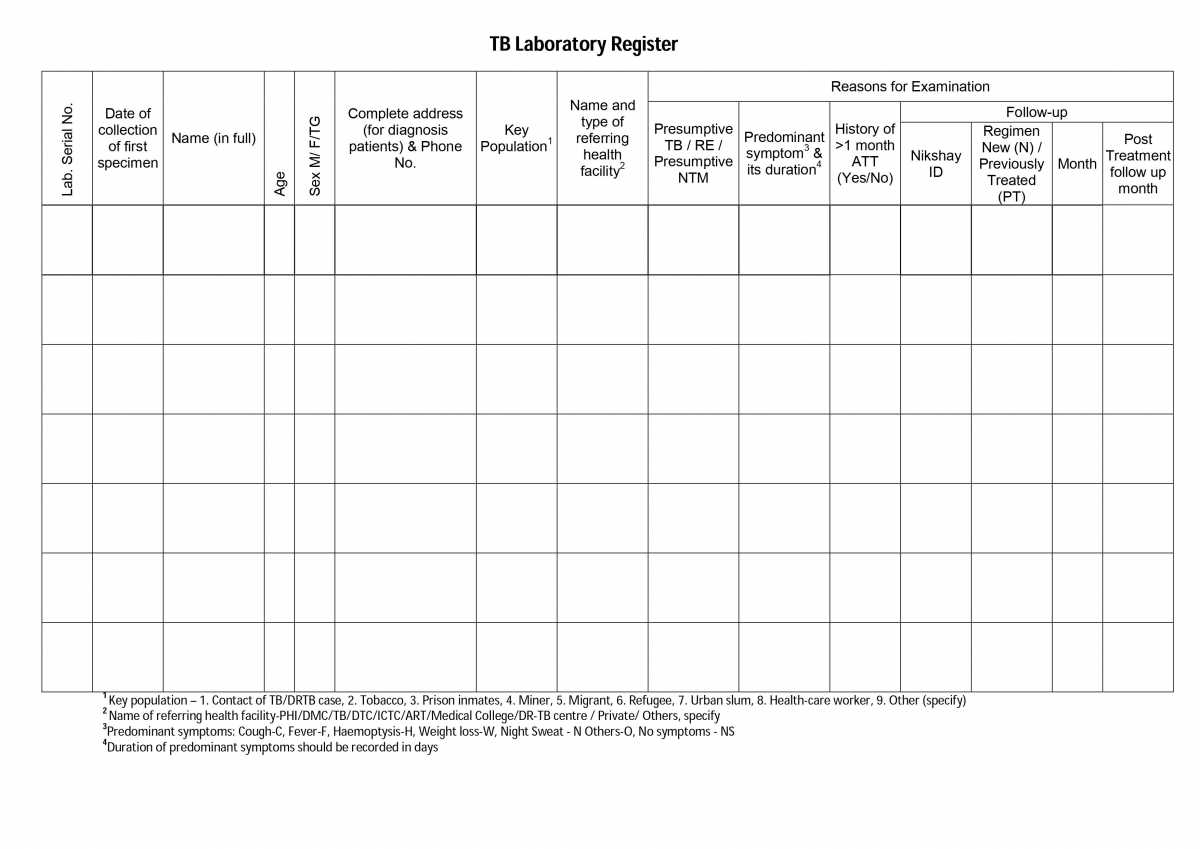
Figure: First Page of the TB Laboratory Register; Source: NTEP Training Modules 1-4 for Programme Managers & Medical Officers, p. 219
Resources
Kindly provide your valuable feedback on the page to the link provided HERE
Drug Susceptibility Testing Logs
ContentMGIT DST testing logs are maintained by the laboratory for QC purposes to record information on the Lot number of MGIT tubes and drugs used along with their expiry dates. A sample DST log is shown here that laboratories can adapt and use as per their requirements:
Image
Resources:
Assessment
Question
Answer 1
Answer 2
Answer 3
Answer 4
Correct answer
Correct explanation
Page id
Part of Pre-test
Part of Post-te
DST logs should contain information on the following:
Lot number of MGIT tube and drugs used Test has to be assigned to a new station NTMs obtained Incubation time for each tube 1 DST logs should contain information on Lot number of MGIT tube and drugs used
Final Result Reporting
ContentFinal Result Reporting
Once the DST results are validated and finalized, these need to be communicated to the requesters. NTEP guidelines mandate the reporting of DST results to the requesting district/physician through Ni-kshay within the stipulated turn-around time. The following steps are involved in reporting the DST results in Ni-kshay:
Step 1: Log in to the Ni-kshay portal and search for the patient whose DST results are being reported by entering the Ni-kshay/episode ID.
Step 2: From the Diagnostic module drop-down, select the ‘add test’ option.
Image
Step 3: Select the appropriate option from the drop-down menu of ‘Reason for testing’ and select ‘DST’ from the ‘Test Type’ drop-down menu.
Step 4: Select the appropriate options in the ‘Facility Details’ section.
Image
Step 5: In the ‘Test details’ sections, after filling in the information about testing and reporting date, select the drug for which the DST is being reported from the drop-down menu of ‘DST to Drug’. Select the Susceptible/Resistant/None (whichever is applicable) option from the drop-down menu of ‘Resistance Status’. Choose the applicable option from the drop-down menu of ‘Final Interpretation’.
Image
Step 6: After adding remarks (if any), hit the ‘submit test’ option to complete the process.
Image
Resource
Guidelines for programmatic Management of Drug-Resistant Tuberculosis in India, 2021.
Assessment
Question
Answer 1
Answer 2
Answer 3
Answer 4
Correct answer
Correct explanation
Page id
Part of Pre-test
Part of Post-test
NTEP guidelines mandate the reporting of DST results to the requesting district/physician through which of these?
Request forms
Lab report form
Ni-kshay
Telephone
3
NTEP guidelines mandate the reporting of DST results to the requesting district/physician through Ni-Akshay within the stipulated turn-around time.
YES
YES
-
CDST_LT: MGIT DST quality control
FullscreenMGIT DST Quality Control
ContentMGIT DST Quality Control
Quality control of MGIT DST is critical to laboratory testing, as it ensures the accuracy and consistency of the test processes and the results reported.
Frequency:
-
For each new batch of reagents (MGIT drug kits, other drugs, media, etc.)
-
Weekly, in a DST run, when patient tests are run weekly.
-
With each batch of patient isolates, when DST is performed less frequently.
-
If the batch QC fails, all the results obtained within that batch and the new batch of a reagent should be thoroughly reviewed, and the testing should be repeated.
Strains used of MGIT DST Quality control:
-
M. tuberculosis H37Rv (ATCC [American Type Culture Collection] number 27294) is used as a QC strain which is susceptible to all anti-tuberculosis drugs. If the ATCC reference strain cannot be obtained, a well-characterized strain derived from a patient’s isolate that is completely susceptible to first-line anti-TB agents may be used instead. It is preferable to use a strain that has been fully sequenced and shown to have a wild-type pattern for all known genes associated with TB drug resistance.
-
It is not necessary to include a resistant strain, as most of the resistant strains against a drug which are available from ATCC and other culture collections are highly resistant and do not give any added benefit in quality control.
Procedure:
The test procedure for QC organisms is the same as for clinical isolates. The inoculum should be from a freshly grown culture in the MGIT medium or on the Löwenstein-Jensen medium (LJ) slant. After a standardized suspension has been made, it should be frozen at -70° C ±10° C. It may be stored for up to 1 year with no significant decrease in viable counts.
Resources
Assessment
Question
Answer 1
Answer 2
Answer 3 Answer 3 Correct answer
Correct explanation
Page id
Part of Pre-test
Part of Post-test
At what temperature and for how long can we store the QC organisms?
2 months at -70° C ±10° C
6 months at -70° C ±10° C
12months at -70° C ±10° C 24 months at -70° C ±10° C 3
After a standardized suspension has been made, QC strains should be frozen at -70° C ±10° C. It may be stored for up to 1 year with no significant decrease in viable counts.
YES
YES
-
Standard Controls
ContentThe definite diagnosis of tuberculosis demands that M. tuberculosis be recovered on culture media and identified using differential in vitro tests. Hence using laboratory standards is an important aspect of ensuring quality processes in all aspects of MGIT DST.
These include the following:
1. Standard laboratory biosafety measures as applicable to TB containment laboratories for handling culture isolated and performing DST
2. Trained staff to use standard operating procedures for equipment and laboratory methods
3. Standard stains for ZN microscopy, reagents and culture media as positive and negative controls
4. Using standard strains with every batch of the medium as a check on drug concentration in drug susceptibility tests
5. Using known standard positive and negative control in all biochemical tests for identification
6. Using standard Laboratory Performance Indicators for Mycobacterial Culture and DST
7. Using standard NTEP registers and formats for day-to-day work and monthly/quarterly abstracts to summarize laboratory activities
Resource
GLI Practical Guide to TB Laboratory Strengthening
Assessment
Question
Answer 1
Answer 2
Answer 3
Answer 4
Correct answer
Correct explanation
Page id
Part of Pre-test
Part of Post-test
Standard laboratory controls used in MGIT DST include which of the following?
Using standard strains with every batch of medium
Using known standard positive and negative control in all biochemical tests for identification
Using standard operating procedures for equipment and laboratory methods
All
4
Ensure that laboratory SOPs and procedures are followed. Using laboratory standards is an important aspect of ensuring quality processes in all aspects of MGIT DST.
YES
YES
Procedure of Quality Control
ContentQuality controls procedures are essential to generate quality DST results. Quality procedures are essential when using QC strains and reagents and preparing and using drugs for DST. These include:
QC strains
1. Use well-characterized pan-susceptible M. TB strain/ H37Rv/ M. tuberculosis ATCC 27294
2. Colonies from solid media less than 14 days old
3. MGIT 960 tube 1–5 days after flagged positively by instrument
4. Additional organisms may be tested to supplement BD QC recommendations
5. Test with a known mono-resistant strain of M. tuberculosisDrug and Inoculum Preparation
1. Ensure proper reconstitution of lyophilized drugs by following the given guidelines:- Rehydrate drugs with sterile distilled water
- Thaw aliquots of prepared drugs from freezer
- Check the expiry date before use
2. Avoid wrong drug concentrations.
3. Avoid improper drug preparation.
4. Proper dilution of inoculum for drug and growth control tube is critical.
5. Suspension must be well mixed and homogeneous without clumps.
6. Prepare QC inoculum (H37Rv) suspension in the same way as patient isolate suspension.7. Use positive and negative controls.
8. Follow standard operating procedures to perform SIRE/ Second-line and PZA DSTs.
Resource
GLI Practical Guide to TB Laboratory Strengthening
Assessment
Question
Answer 1
Answer 2
Answer 3
Answer 4
Correct answer
Correct explanation
Page id
Part of Pre-test
Part of Post-test
Which of the following procedures are included in the quality control of MGIT DST?
Prepare QC inoculum (H37Rv) suspension in the same way as patient isolate suspension.
Use well-characterized pan-susceptible M. TB strain/ H37Rv/ M. tuberculosis ATCC 27294 .
Ensure proper reconstitution of lyophilized drugs.
All 4
Quality procedures are essential when using QC strains and reagents and preparing and using drugs for DST.
YES
YES
Quality Control of the MGIT DST Inoculum
ContentQuality control of MGIT DST inoculum is essential for quality DST results. The different aspects of inoculum preparation include:
1. Using the right inoculum
2. Using pure cultures only
3. Using fresh cultures
4. Using slant < 14 daysQuality aspects for Positive MGIT tube include:
1. Time period should be plus 1 day to 5 days from the date of positivity
2. Homogeneous inoculum
3. Using sterile glass beads and vortex to break up organism clumps
4. Too high or too low an inoculum may give error results or un-interpretable results
5. Preparing dilutions according to the procedure
6. Using an accurate pipette to add inoculum to tubesResource
GLI Practical Guide to TB Laboratory Strengthening
Assessment
Question
Answer 1
Answer 2
Answer 3
Answer 4
Correct answer
Correct explanation
Page id
Part of Pre-test
Part of Post-test
Quality control of MGIT DST inoculum includes which of the following?
High inoculum
Time period to be plus 1 day to 5 days from the date of positivity
Non-homogenous suspension
21-day-old culture
2
The time period should be plus 1 day to 5 days from the date of positivity.
YES
YES
Quality Control in DST results interpretation
ContentQuality Control of DST is critical to ensure the test is functioning properly so that reliable results can be interpreted.
Steps in Quality Control in DST result interpretation include:
1. SIRE/ Second- line and PZA QC
- Carefully entering the tubes into MGIT 960
- Carefully scanning the DST set carrier into the BACTEC MGIT 960 instrument.
2. Interpretation of results
- The time period to interpret results is crucial. Interpret between 4–13 days for first and second-line drugs and 4-21 days for PZA.
- Results should read susceptible for all drugs.
- If proper results are not obtained, repeat the test.
3. First and Second- line drugs and PZA QC Records
- Record lot numbers of MGIT 960 tubes, drugs and drug supplements.
- Record QC results.
- Maintain records for a minimum of five years.
Resource
GLI Practical Guide to TB Laboratory Strengthening
Assessment
Question
Answer 1
Answer 2
Answer 3
Answer 4
Correct answer
Correct explanation
Page id
Part of Pre-test
Part of Post-test
Quality control in DST result interpretation includes which of the following?
Interpret the results between 4–13 days for first and second-line drugs and 4-21 days for PZA.
Ensure proper reconstitution of lyophilized drugs.
Use calibrated pipette.
Use control strains and reagents, 1
Interpret the results between 4–13 days for first and second-line drugs and 4-21 days for PZA.
YES
YES
-
CDST_LT: Quality assurance of TB Culture & DST laboratories
FullscreenQuality Assurance in TB C&DST Laboratories
ContentQuality Assurance (QA) is important to ensure quality DST results from a Culture and DST laboratory.
Foremost, it is essential to develop a Quality Assurance Plan that is practical and meets the laboratory requirements. It is important to ensure that specific procedures are available for specific components of the plan.
The QA plan should address the following:
1. General Laboratory Systems
2. Examination Phase of Testing (analytical)
3. Pre-Examination Phase of Testing (pre-analytical).
4. Post- Examination Phase of Testing (post-analytical)
With regards to QA, it is essential that the plan is designed to improve the following:
- Reliability
- Efficiency
- Use of laboratory services in order to achieve the required technical quality in laboratory diagnosis.
- Continuously improve the reliability and efficiency of laboratory services
- Includes quality control, external quality assessment, and quality improvement
Resource
GLI Practical Guide to TB Laboratory Strengthening
Assessment
Question
Answer 1
Answer 2
Answer 3
Answer 4
Correct answer
Correct explanation
Page id
Part of Pre-test
Part of Post-test
Quality Assurance in the C&DST laboratory includes which of the following?
General Laboratory Systems
Examination Phase of Testing
Pre-Examination Phase of Testing
All 4
Quality Assurance in the C&DST laboratory includes General Laboratory functioning and all aspects in the pre-post and examination phases.
YES
YES
C&DST Laboratory Arrangement and Administration
ContentQuality Control in Laboratory Arrangement and Administration
Laboratory Arrangement
- The laboratory should be arranged in a configuration which segregates clean areas from the dirtiest areas of the laboratory.
- Work areas, equipment and supplies must be arranged for logical and efficient workflow.
- Restricted access to containment areas; ensure that the doors are always closed during the work.
- Work areas should be clean, and work surfaces should be swabbed after each use with an appropriate disinfectant.
Laboratory Management And Administration
- Written procedures are maintained for easy reference.
- Quality control procedures must be implemented.
- Quality Control data must be reviewed at regular intervals.
- Records and registers must be maintained.
- Management of procurements: Equipment/ Consumables acceptance
- Tests and services must be scheduled.
- Proper management of biomedical waste must be done.
Resource
GLI Practical Guide to TB Laboratory Strengthening
Assessment
Question
Answer 1
Answer 2
Answer 3
Answer 4
Correct answer
Correct explanation
Page id
Part of Pre-test
Part of Post-test
Quality Control in Laboratory Arrangement and Administration includes which of the following processes?
The laboratory should be arranged in a configuration which segregates clean areas from the dirtiest areas of the laboratory.
Use a wide mouth beaker to prepare reagents.
Use non-homogenous suspension.
Use of 21-day-old culture.
1
The laboratory should be arranged in a configuration which segregates clean areas from the dirtiest areas of the laboratory.
YES
YES
Pre-examination QA Procedures in C&DST Laboratories
ContentThe pre-Examination Procedure for Quality Assurance of TB and DST Laboratories includes the following aspects during post-analytical aspects:
1. Giving proper instructions to collect and transport good quality specimens:
Appropriate specimens
Collection, transportation procedures
2. Specimen monitoring requirements:
Documentation of specimen quality
Specimen rejection policy
3. Test requests:
Essential documentation (patient name, specimen source, diagnostic and/ or follow-up, collection date)
Compared to the specimen for consistencyResource
GLI Practical Guide to TB Laboratory Strengthening
Assessment
Question
Answer 1
Answer 2
Answer 3
Answer 4
Correct answer
Correct explanation
Page id
Part of Pre-test
Part of Post-test
The pre-examination Quality Control in C&DST includes which of the following?
Giving proper instructions to collect and transport good quality specimens
Transporting samples after 3 days
Discarding inadequate samples
Use of 21-day-old culture
1
Giving proper instructions to collect and transport good quality specimens is a part of the pre-examination Quality Control in C&DST.
YES
YES
Examination QA Procedures in C&DST Laboratories
ContentThe examination procedure for Quality Assurance of TB and DST Laboratories includes:
1. Standard Operating Procedures (SOP)
Updated annually or more often as needed
Reviewed and initiated by staff annually
Obsolete procedures removed, labelled as “Obsolete”2. Calibration/ Validation- Equipment
Biosafety cabinets
Safety centrifuges and autoclaves
Thermometers, pipettes and timers3. Validation of new methods/procedures
All new methods are evaluated against the reference/gold standard for:
Sensitivity
Specificity
Positive predictive value
Negative predictive value
Turn-around time Resource
GLI Practical Guide to TB Laboratory Strengthening
Assessment
Question
Answer 1
Answer 2
Answer 3
Answer 4
Correct answer
Correct explanation
Page id
Part of Pre-test
Part of Post-test
The examination procedure for Quality Control in C&DST includes which of the following?
Giving proper instructions to collect and transport good quality specimens
Using standard Operating Procedures (SOP)
Discarding inadequate samples
Using expired reagents
2
Using standard Operating Procedures (SOP) is a part of the examination procedure for Quality Control in C&DST.
YES
YES
Post-examination QA Procedures in C&DST Laboratories
ContentPost-examination QA Procedures in C&DST Laboratories
Post-examination (also post-analytical phase) is one of the three-phase frameworks for the total testing process to describe issues related to the quality of laboratory testing. Most common laboratory errors occur following the testing of the sample, and some of these may be more difficult to detect. Common examples of these errors include making a transcription error when preparing the report; sending the report to the wrong location, which often results in complete loss of the report; failing to send the report.
All the C&DST laboratories should have procedures in place to ensure the validation of post-examination processes in the laboratory. These include:
-
Validation of the results: In this procedure, a review is done to verify that all the data and results in the Result Report have correctly been transcribed from the Request Form, the work forms, and the register. It must also be verified that results are legible and that quality controls were correctly performed on the day the results were produced (to determine if the examinations were performed correctly and that reagents and equipment were performing correctly). The person authorized to perform this procedure must be somebody in a management position (either the head of the data management section, the head of the section where the testing was performed or the laboratory manager him/herself).
-
Delivery of reports: All the C&DST laboratories should have a written protocol for sending the Result Reports to the requesters. There are two important requirements for choosing a method of sending the results: the method of sending Result Reports must have a minimal risk of losing Result Reports, and the Result Reports must always be transmitted promptly. Under NTEP, all C&DST laboratories should use the web-based portal- Ni-kshay- to send test reports. However, an alternative method should also be kept as a backup in case Ni-kshay does not work. In addition, all the C&DST laboratories should write a detailed SOP for the same.
-
Turn-around-Time (TAT): NTEP has already defined the TAT for all the diagnostics tests. The C&DST laboratory should be able to complete the test requested and report the results in Ni-kshay within the defined TAT. Period reviews should be done to ensure that the results are reported within the permissible TAT. The person authorized to perform this procedure must be somebody in a management position.
-
Result audit: Periodic internal audits should be done by the C&DST laboratory on the results reported. These audits should include the entire pathway of the laboratory activities, from validating results to reporting the results in Ni-kshay.
Resource
Laboratory quality management system: Handbook. World Health Organization
Assessment
Question
Answer 1
Answer 2
Answer 3
Answer 4
Correct answer
Correct explanation
Page id
Part of Pre-test
Part of Post-test
Post-examination phase is also known as which of the following?
Post-examination phase is also known as?
Analytical phase
Pre-analytical phase
Pre-examination phase
Post-analytical phase
4
Post-examination (also post-analytical phase) is one of the three-phase frameworks for the total testing process to describe issues related to the quality of laboratory testing.
YES
YES
-
Quality Improvement Activities in C&DST Laboratories
ContentQuality Improvement Activities in C&DST Laboratories
Continuous Quality Improvement is defined as “a philosophy and attitude for analyzing capabilities and processes and improving them repeatedly to achieve the objective of customer satisfaction”. Quality improvement (QI) is a critical and often neglected part of the quality assurance process. The QI cycle involves four steps: Plan, Do, Check, and Act.
Image
Key Components of the QI Process:
Identification of non-conformities through data collection, subsequent data analysis, and creative problem-solving are key components of the QI process. This involves continual monitoring and identifying and analyzing actual and potential defects.
Identification of non-conformities:
Non-conformities may be identified in many ways, including Proficiency Testing (PT), reviewing quality indicators, reporting issues identified by staff members, and audits.
-
Proficiency Testing: PT verifies that the C&DST laboratories are proficient in their testing process and can obtain accurate and reliable results. All the C&DST laboratories under NTEP receive an annual panel of 20 culture isolates from their respective National Reference laboratories (NRLs). PT helps to identify major non-conformities, allowing NRLs to target the most poorly performing C&DST laboratories for on-site supervision. PT panels may also be used to evaluate the training needs of technicians.
-
Reviewing quality indicators: All C&DST laboratories should collect and analyze testing data on at least a monthly basis, using a standardized format. Targets should be set for all indicators monitored, and any unexplained change in quality indicators, such as an increase in error rates and contamination rates, a change in MTB positivity rate or rifampicin resistance rate, or a significant change in the volume of tests conducted, should be documented and investigated. Quality performance indicators should be reviewed by the laboratory manager and must always be linked to corrective actions if any unexpected results or trends are observed.
-
Audit: An assessment, or audit, allows the laboratory to understand its performance when compared to a benchmark or standard. There are two types of audits- external and internal audits.
Audits should include the evaluation of steps in the whole laboratory path of workflow. They should be able to detect problems throughout the entire process. The value of a well-designed audit is that it will reveal weaknesses in the pre-examination, examination, and post-examination phases. During audits, information is gathered about: processes and operating procedures, staff competence and training, equipment, environment, handling of samples, quality control and verification of results, recording practices, and reporting practices.
Procedures for identifying non-conformities, determining responsibility, recalling the results associated with the non-conformities, and resuming routine testing following corrective actions must be clearly defined by all the C&DST laboratories. In addition, follow-up actions must also be implemented to prevent the same non-conformity from occurring in the future.
Resources
GLI Practical Guide to TB Laboratory Strengthening
Assessment
Question
Answer 1
Answer 2
Answer 3
Answer 4
Correct answer
Correct explanation
Page id
Part of Pre-test
Part of Post-test
Plan, Do, Check, and Act are the four essential steps of which cycle?
Quality control cycle
Quality assurance cycle
Quality improvement cycle
None of the above
3
The QI cycle involves four steps: Plan, Do, Check, and Act.
YES
YES
-
External Quality Assurance for C&DST laboratories
ContentExternal Quality Assurance for C&DST laboratories
External Quality Assurance (EQA) is a critical component of laboratory testing, as it ensures the accuracy and consistency of laboratory test processes throughout the examination of the specimen – from the point of collection to result reporting and database entry. The EQA of the C&DST laboratory under NTEP is through structured On-Site Evaluation (OSE), panel testing and retesting exercise.
On-Site Evaluation
A field visit is an ideal way to obtain a realistic assessment of the conditions and skills practised in the laboratory. On-site evaluation of C&DST Laboratory is therefore an essential component of a meaningful Quality Assurance (QA) programme. The visit includes a comprehensive assessment of laboratory safety, including infection control measures, conditions of equipment, adequacy of supplies, as well as the technical components of culture and DST. All the C&DST laboratories are visited at least once a year by their respective NRLs for this activity. A standard comprehensive checklist for on-site evaluation of the C&DST laboratory is available. Any significant problems identified are documented in the final report.
Panel testing:
The National reference laboratory (NRL) sends a panel of 20 strains to the C&DST laboratory every year. This panel consists of known pan-sensitive, mono-resistant, Multi-drug resistant (MDR) and poly-resistant strains and some isolates in duplicate to check for reproducibility. The C&DST laboratory sub-culture these 20 strains and then set up Drug Susceptibility Testing (DST). The results of DST are then communicated back to the NRL. The NRL checks for concordance between the results of the C&DST laboratory and their own results. The acceptable concordance level as per the NTEP guideline, is >90%.
Retesting:
10 randomly selected recent cultures with known sensitivity patterns from a C&DST laboratory are retested at the NRL. The results are then checked for concordance. This is generally a one-time activity conducted at the time of accreditation of the C&CST laboratory.
Resources
Assessment
Question
Answer 1
Answer 2
Answer 3
Answer 4
Correct answer
Correct explanation
Page id
Part of Pre-test
Part of Post-test
For Retesting, 20 randomly selected recent cultures with known sensitivity patterns from a C&DST laboratory are retested at the NRL.
True
False
2
10 randomly selected recent cultures with known sensitivity patterns from a C&DST laboratory are retested at the NRL.
YES
YES
Why is EQA a critical component of laboratory testing? Helps build the necessary skills for laboratory test processes Ensures the accuracy and consistency of laboratory test processes Collects and reports accurate results Improves the speed of laboratory test processes 2 External Quality Assurance (EQA) is a critical component of laboratory testing, as it ensures the accuracy and consistency of laboratory test processes throughout the examination of the specimen – from the point of collection to result reporting and database entry. YES YES
Fullscreen