Limitations of First-line Line Probe Assay [FL-LPA]
First Line - Line Probe Assay (FL - LPA) can detect the mutations that are most frequently identified in resistant strains.
However, there are certain limitations of the test as follows:


First Line - Line Probe Assay (FL - LPA) can detect the mutations that are most frequently identified in resistant strains.
However, there are certain limitations of the test as follows:
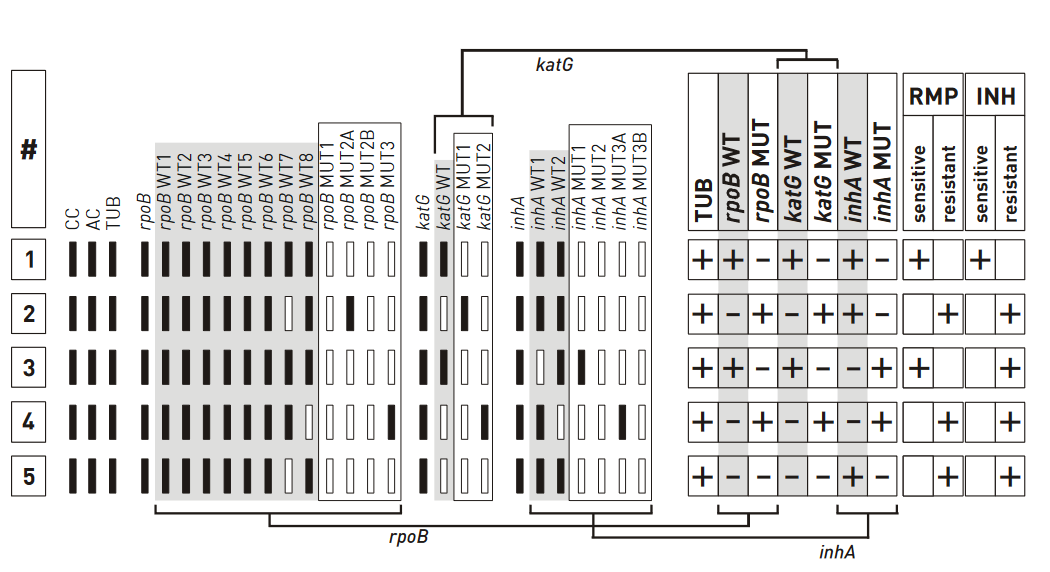
xamples of banding patterns for First Line - Line Probe Assay (FL - LPA) are shown in figure below.
Description
Predicting Drug Resistance in Special Cases
Zone developed/ not developed (failed) in Wild Type (WT) and Mutation (MUT) probes are used to predict drugs resistance in Second Line - Line Probe Assay (SL - LPA).
For Fluoroquinolones (FLQ)
Tables 1 and 2 show mutations in gyrA, gyrB genes and corresponding WT, MUT and responsible codons and mutations:
Each strip for Second Line - Line Probe Assay (SL - LPA) has a total of 27 reaction zones (Figure below).
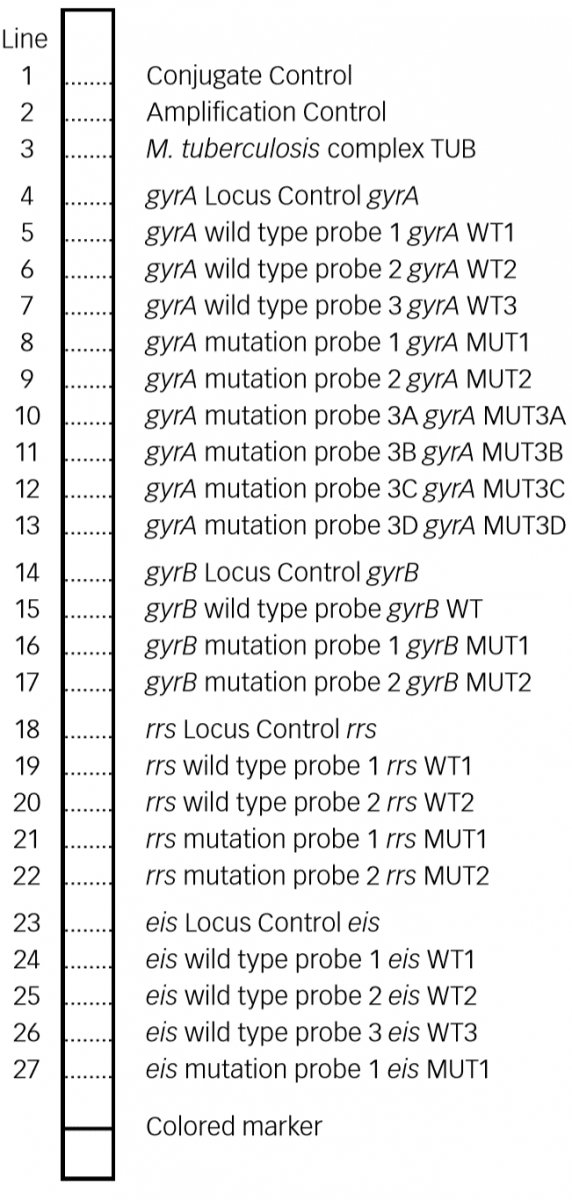
Figure: Key Zones of SL - LPA Evaluation Strip; Source: GenoType MTBDRsl VER 2.0 kit, Instructions for Use.
Evaluation of Assay Strip for SL- LPA Zones:
Each strip for First Line – Line Probe Assay (FL - LPA) has a total of 27 reaction zones (Figure below).
The Key Zones Include:
Conjugate Control (CC)
Amplification Control (AC)
M. tuberculosis Complex (TUB)
Do’s and Don’ts for Contamination Control
DO’s
General Instructions
Test Reagents Kits Used for First Line (FL) and Second Line (SL) Line Probe Assay (LPA)
Components of kits are shown in the following table.
|
COMPONENTS OF FL LPA KIT |
COMPONENTS OF SL LPA KIT |
|---|
Purpose of DNA extraction
For Line Probe Assay (LPA), DNA is extracted from:
Extraction of DNA from a clinical specimen and culture isolates (LJ, liquid) is shown in the figure below: