Senior Treatment Supervisors [STS] and their role
Senior Treatment Supervisor (STS) is one of the key programme staff working under NTEP at TU level.
Roles and responsibilities of STS include:


Content Status where the content is approved for use.
Senior Treatment Supervisor (STS) is one of the key programme staff working under NTEP at TU level.
Roles and responsibilities of STS include:
Risk Population for TB Infection
Figure: High Risk Group population for TB Infection
The National TB Elimination Programme (NTEP) has a standard procedure for sputum smear preparation, the steps for which are listed below:
The tools required for smear preparation include a clean work surface, new and clean glass slides, a discard bucket or a foot-operated bin with a plastic liner, bamboo or wooden applicator sticks or sterile wire loop, spirit lamp and a rack for drying smears.
Zoonotic Tuberculosis (zTB) is not a new disease but has long been neglected. Majority of tuberculosis (TB) cases in humans are caused by Mycobacterium tuberculosis (M. tuberculosis). A number of other organisms from the M. tuberculosis complex (MTBC), present in animals and the environment, can cause zoonotic TB (zTB), these include M. canetti, M. bovis, M. caprae, M. microti, M. pinnipedii, M. mungi, and M. orygis.
The Truenat Assay Technology works on Real-time Polymerase Chain Reaction (PCR).
The key steps include:
The interaction between HIV and TB in co-infected persons is bidirectional and synergistic; on the one hand, HIV infection predisposes the development of active TB, and, on the other, the course of HIV-related immunodeficiency is worsened by active TB infection.
Under the National TB Elimination Program (NTEP), Drug-resistant TB (DR-TB) patients receive standardized DR-TB treatment boxes (called Patient-wise Boxes - PWB) for each month. These boxes are either with the health facility nearest to DR-TB patients (DOT centre) or with the treatment supporter who is involved in the care of DR-TB patients.
Steps involved in the preparation of second-line drug boxes for DR-TB patients:
Tuberculosis (TB) unit (TU) is the sub-district level supervisory unit of National TB Elimination Program with the following organogram:
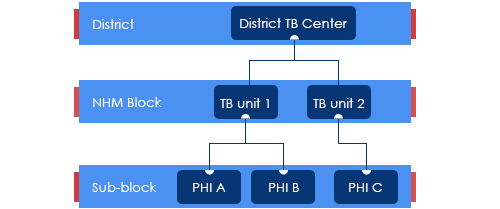
Figure: Organogram of a TB Unit
(PHI: Peripheral Health Institution)
TUs are based mainly on National Health Mission (NHM) health blocks with the aim of aligning with the NHM Block Programme Management Unit (BPMU) for optimum resource utilization and appropriate monitoring.
The most common situations that need troubleshooting while using CBNAAT are:
Troubleshooting Approach
The extra-pulmonary samples (Non-sputum) can also be processed and used for MTB and Rif diagnosis using Truenat. The processing of various extra-pulmonary samples is described below.
Reagents required:
Trueprep AUTO MTB Sample Pre-treatment Pack for sample processing
Steps in processing of non-sputum samples
