Newer Anti-TB Drugs
- Read more about Newer Anti-TB Drugs
- Log in to post comments
 Figure: Sirturo 100 mg Bedaquiline Tablets
|


Figure: Sirturo 100 mg Bedaquiline Tablets
|
The dosage for Drug-resistant TB (DR-TB) drugs used in the regimen by weight bands for adults are enumerated in the table below.
|
SR NO |
|---|
Compared to Drug-sensitive TB (DS-TB), Drug-resistant TB (DR-TB) is more challenging in terms of:
Certain drugs can be used safely while others need to be avoided along with Bedaquiline (Bdq).
The table below provides the list of drugs that should be avoided when Bdq is part of the regimen as well as the drugs that are safe to use with Bdq.
|
GROUP |
SAFE TO USE |
DRUGS TO BE AVOIDED |
|---|
The anti-TB drugs recommended for treatment of Multi- and Extensively Drug-resistant (M/XDR) TB patients are grouped into three groups – A, B and C (Figure below).
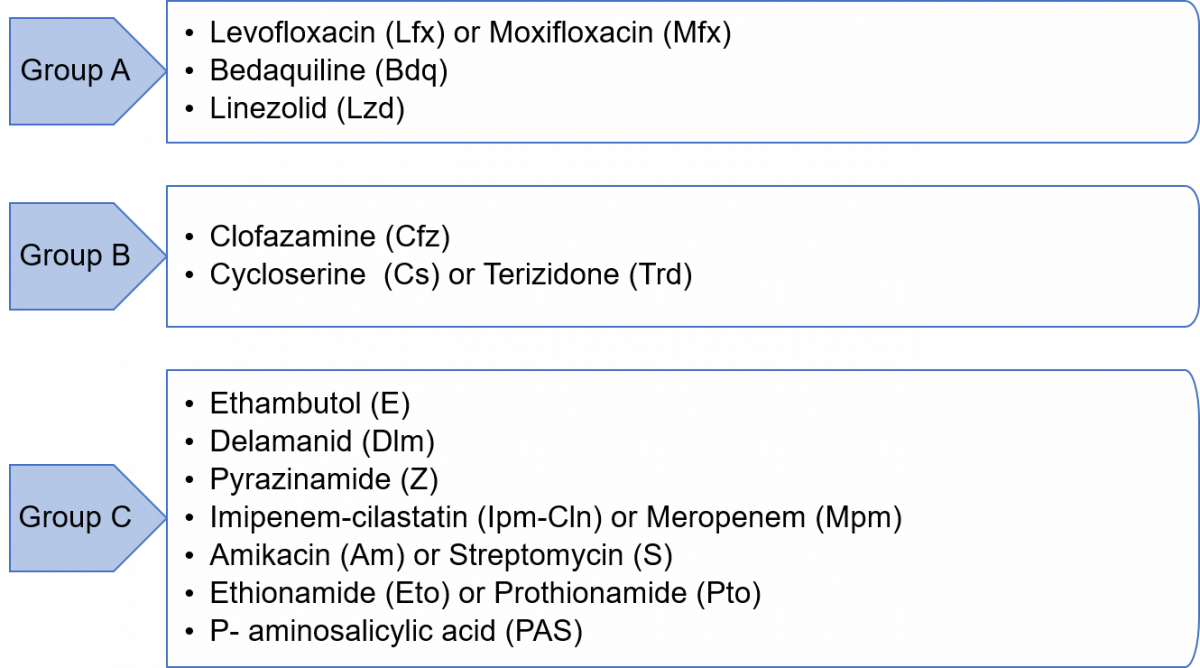
Figure: Groups A, B and C of Anti-TB Drugs used in Treatment of M/XDR-TB Patients

Figure: Summary of the Sustainable Development Goals
The process of receipt of drugs is completed through the Ni-kshay Aushadhi application. Once a consignment is dispatched to the receiving unit, the system will display following three options:
The National TB Elimination Programme (NTEP) strives to ensure an uninterrupted supply of drugs, and stocking norms have been developed by the Central TB Division (CTD) to help achieve this goal.
The drug stocks equivalent to 10 months of consumption, shall be maintained with implementing states.
The table shows the quantity of reserve stocks at each level at the start of the quarter (considering the receipt from one higher level).
Under the National TB Elimination Programme (NTEP), the anti-TB drugs are procured at the centre level by the Central TB Division (CTD), Ministry of Health and Family Welfare (MoHFW), and supplied to the central warehouses.
From the central level warehouses, the drugs are supplied to different State Drug Stores (SDS) and further distributed to District Drug Stores (DDS) and sub-district level (TB Unit (TU) Store and Peripheral Health Institute (PHI)).
This movement of drug flow is monitored in real-time through Ni-kshay Aushadhi.
The Adherence Summary dashboard is designed primarily for treatment supporters and field staff to help them monitor the day to day adherence statistics of their patients and incorporate necessary actions wherever required. This dashboard enables staff at district level hierarchies and below to view real-time adherence information of all patients on treatment.
The adherence summary dashboard is available in both Ni-kshay web portal as well as the mobile application.