Treatment Regimen for Non-Mycobacterium Tuberculosis [NTM]

The suggested treatment regimen covering maximum non-Mycobacterium Tuberculosis (NTM) mainly Mycobacterium Avium Complex (MAC) is as follows: 

  • Rifampicin (R) 450-600 mg OD
  • Ethambutol (E) 800-1200 mg OD
  • Clarithromycin (Clr) 1 gm OD (split into two doses)
  • Add injection Amikacin (Am) 750 mg – 1 gm thrice weekly for the first 2-3 months


Intensive Phase (IP) is for 3 months and can be extended to a maximum of 6 months with all four drugs. 
 

Patient-wise Drug Boxes: Packing Instructions

Packaging of loose drugs into monthly patient-wise boxes should be done under the guidance of those in charge of drug logistics at the state and district levels.


Patient-wise drug box preparation should be done for the following Drug-resistant TB (DR-TB) regimens:

  1. Shorter oral Bedaquiline-containing Multidrug-resistant/ Rifampicin-resistant TB (MDR/RR-TB) regimen
  2. Longer oral Multi (M)/ Extensively Drug-resistant TB (XDR-TB) regimen
  3. Isoniazid (H) mono/poly DR-TB regimen


Tuberculosis Unit [TU]

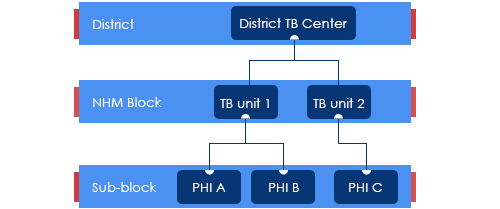
Tuberculosis (TB) unit (TU) is the sub-district level supervisory unit of National TB Elimination Program with the following organogram:

Figure: Organogram of a TB Unit


(PHI: Peripheral Health Institution)

TUs are based mainly on National Health Mission (NHM) health blocks with the aim of aligning with the NHM Block Programme Management Unit (BPMU) for optimum resource utilization and appropriate monitoring.

District TB Centre and its Functions

The key level for the management of public health services is the district​ level. The District Tuberculosis Centre (DTC) is the nodal point for tuberculosis (TB) control activities in the district​.


Functions of the DTC

The primary role of the DTC is a managerial one. The DTC is the central program management unit of the district responsible for all activities related to National TB Elimination Programme (NTEP) implementation such as:

Adverse Drug Reactions due to Longer oral M/XDR-TB Regimen

The table below showcases the adverse drug events that may be caused by drugs used for longer oral Multi (M)/ Extensively Drug-resistant TB (XDR-TB) regimen. In these situations, replacement drugs are used instead of these drugs.


Table: Possible Adverse Drug Events in the Longer Oral M/XDR-TB Regimen

ADVERSE DRUG EVENTS

DRUGS

QT prolongation

Shorter Oral Bedaquiline-containing MDR/RR-TB Regimen: Treatment Extension

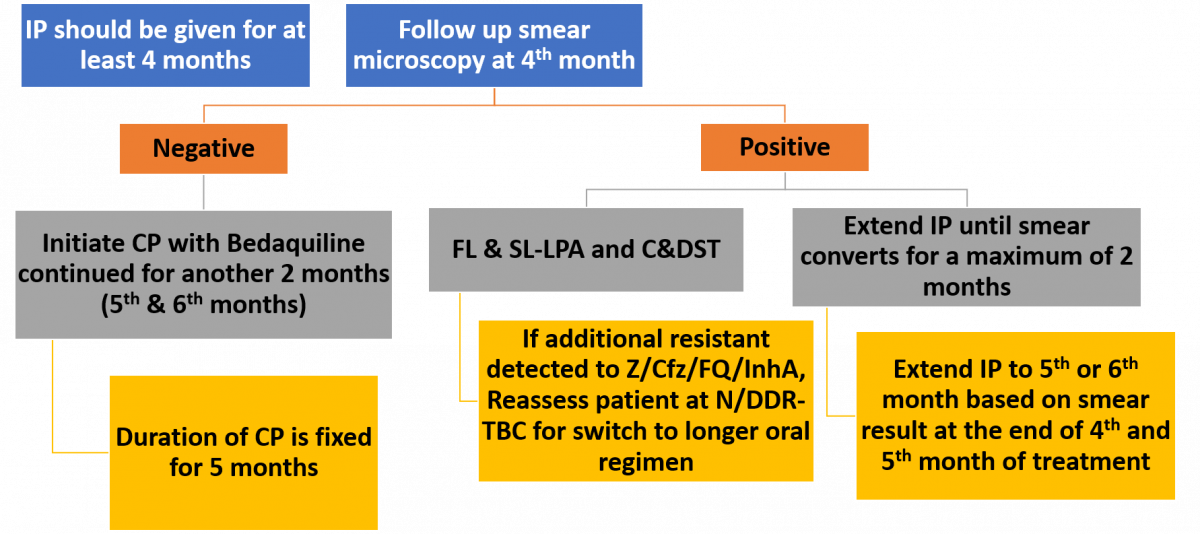
The total duration of treatment in this regimen is 9-11 months with Intensive Phase (IP) at least 4 months and Continuation Phase (CP) for 5 months. Treatment extension of IP is done up to 2 months based on follow-up results and is indicated in the algorithm presented in the figure below.


Figure: Treatment Extension/ Regimen Change Based on Follow up Smear/ Culture/ DST Results


Shorter oral Bedaquiline-containing MDR/RR-TB regimen

Based on the World Health Organization (WHO) treatment guidelines, 2020 recommendations, the National TB Elimination Programme (NTEP) have decided to transition from the current shorter injectable-containing Multi-drug Resistant (MDR)/ Rifampicin-resistant TB (RR-TB) regimen to the shorter oral bedaquiline-containing MDR/RR-TB regimen in the year 2021.​


Salient Features of the Shorter Oral Bedaquiline-containing MDR/RR-TB Regimen


Subscribe to Pharmacist/ Storekeeper (SDS)