Qualities of a good sputum smear

Good quality smears are essential for accurate examination and results. A good quality sputum smear is one that is of uniform thickness and made from the mucopurulent portion of the sample in the center of the slide (Figure 1).


Do’s and Don’ts of a Good Quality Smear

  • Do ensure that the smear size is 3 cm by 2 cm
  • Do ensure there are no fingerprints on the prepared smear

 

Cleaning and Labelling Slide

A Laboratory Serial Number is assigned to each presumptive TB patient who is examined at the microscopy centre.


Each Laboratory Technician (LT) needs to ensure that all the slides are labelled using the Laboratory Serial Number. This is essential for recording as well as for the review of the slide during the supervisory visit as well as during the quality assurance exercise.


For every test, a new slide needs to be used. It is essential that there are no fingerprints or any scratches on the side of the slide (see figure 1).

Making the smear

The National TB Elimination Programme (NTEP) has a standard procedure for sputum smear preparation, the steps for which are listed below:


The tools required for smear preparation include a clean work surface, new and clean glass slides, a discard bucket or a foot-operated bin with a plastic liner, bamboo or wooden applicator sticks or sterile wire loop, spirit lamp and a rack for drying smears.

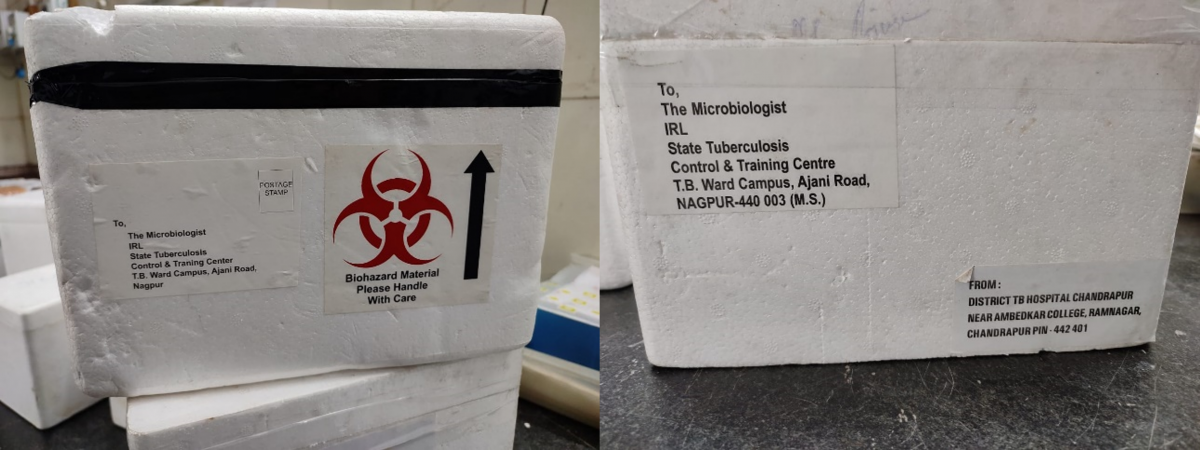
Requirements for Packaging a biological Specimen

Peripheral Laboratories in the NTEP need to send biological samples (such as sputum) to nearby Culture and Drug Susceptibility Testing (CDST) laboratories for advanced testing (eg Drug Resistance Testing). The samples need to be safely packaged and transported such that there is no spillage or contamination.

The items required for safe packaging biological specimens are: 

Technical Specifications for Labelling Specimen Transport Carriers

These are the technical specifications for labelling specimen transport carriers:


  • Specimen containers need to be labelled legibly with details such as the patients’ name, date and time of specimen collection, TB detection centre/ District Tuberculosis Centre (DTC), lab no., specimen A or B.

Figure: Details to be filled on the specimen containers


Universal DST [UDST]

Drug Susceptibility Testing (DST) refers to in-vitro testing using either of the phenotypic methods to determine susceptibility. Drug Resistance Testing (DRT) refers to in-vitro testing using genotypic methods (molecular techniques) to determine resistance.    


Universal Drug Susceptibility Testing (UDST) refers to universal access to rapid DST for at least Rifampicin (R), and further DST for at least Fluoroquinolones (FQs) among all TB patients with rifampicin-resistance.

National Reference Laboratories [NRL]

The National Reference Laboratories (NRLs) constitute the third tier of the National Tuberculosis Elimination Programme (NTEP) laboratory network hierarchy. 


They provide quality assurance and certification services for the Culture and Drug Susceptibility Testing (C&DST) labs and coordinate with the World Health Organisation (WHO) Supranational Reference Laboratory (SNRL) network.


There are six designated NRLs which are delineated in the figure below.

Subscribe to