

Cascade of Care for DR-TB Patients in the Private Sector
ContentThe Drug-resistant Tuberculosis (DR-TB) care cascade is to be ensured for every patient notified/ referred.
The figure below showcases the flow of care cascade for a patient seeking care in the private sector.
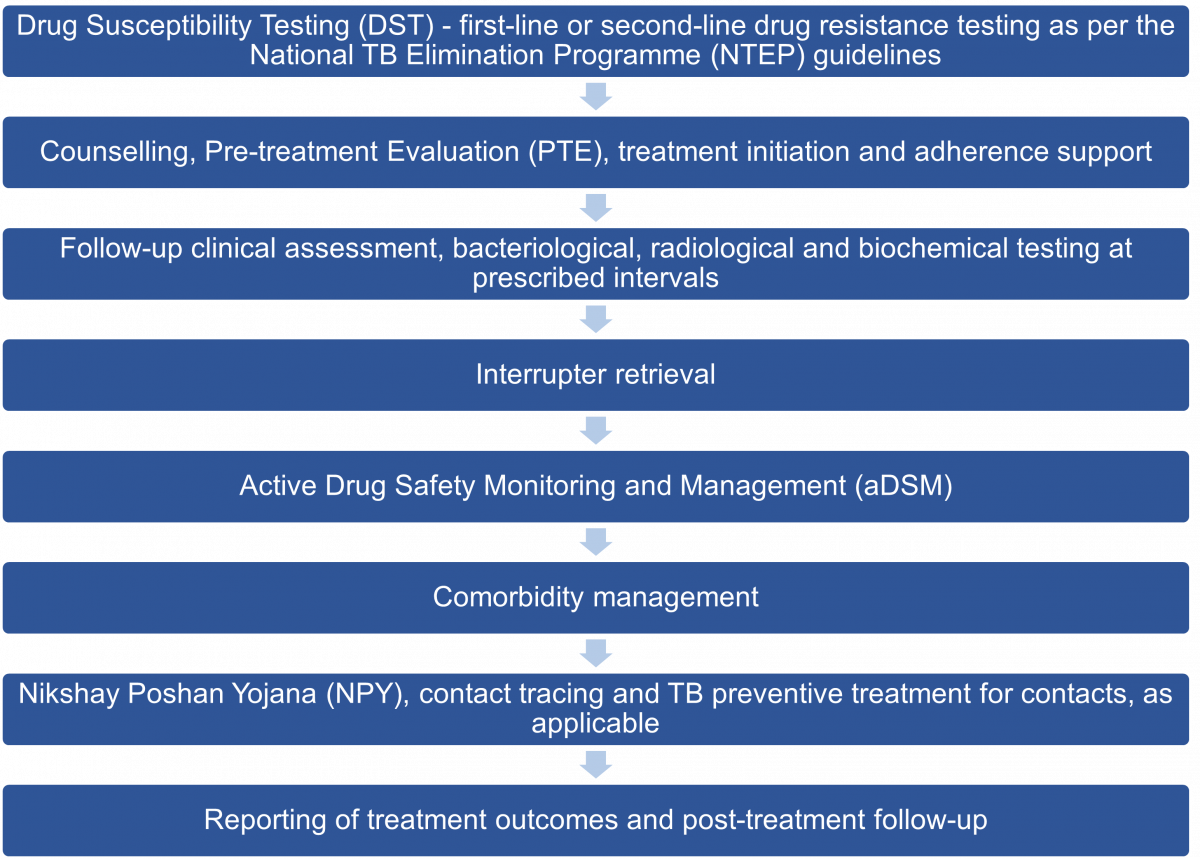
Figure: Flow of Care Cascade for a Patient Seeking Care in the Private Sector
Resources
Kindly provide your valuable feedback on the page to the link provided HERE
Drug-resistant TB Service Linkages to Private Sectors
ContentIt is a well-known fact that although free, quality diagnostic, treatment and patient support services are available in the public health sector, a significant number of patients seek health services from the large, unorganized private health sector.
Reaching out to these patients is important to:
- Deliver essential public health services to prevent the spread of disease and emergence of drug-resistance
- Support TB patients on treatment
- Address co-morbidities that adversely affect treatment outcomes
Additionally, healthcare-seeking is also guided by the willingness on the part of the patient as well as the provider.
A TB patient seeking care in the private sector should come in the purview of the National TB Elimination Programme (NTEP) through notification or referral.
There are at least three different ways that programme officers can expand drug-resistant TB (DR-TB) treatment services using the Guidance Document on Partnerships. They are:
- DR-TB centre inpatient services
- DR-TB centre on an outpatient basis
- Provision of consultation charges for the private specialist to support public sector DR-TB centres in clinical management
Resources
- Guidelines for Programmatic Management of Drug-resistant TB in India, 2021
- Guidance Document on Partnerships, 2019
Kindly provide your valuable feedback on the page to the link provided HERE
DR-TB Services Referral Linkage Scenario 1: Patient Notified from the Private Sector
ContentThe National TB Elimination Program (NTEP) makes an effort to provide Tuberculosis (TB) services to each TB patient, including services to Drug-resistant TB (DR-TB) patients notified/ referred from the private sector.
- It is assumed that a TB/ DR-TB patient who has been notified on Nikshay from the private sector is seeking care from a health facility that is already engaged by the NTEP.
- This engagement could have been established by the NTEP or a public health department directly or through a Patient Provider Support Agency (PPSA) or any other Non-government Organization (NGO)/ partner agency.
- TB patients (diagnosed and treated in the private sector) under the notification act are notified to NTEP from the private Health Facility (HF) using the digital surveillance system - Nikshay.
- It is the responsibility of the local public health and NTEP staff to reach out to the private provider directly or through PPSA and ensure that the TB care cascade is followed for the patient as per the NTEP guidelines or standards of TB care.
Resources
Kindly provide your valuable feedback on the page to the link provided HERE
DR-TB Service Referral Linkages Scenario 3: DR-TB Patient Referred for Treatment from the Private Sector with Bacteriological Confirmation in the Private Sector
ContentMany times, Drug-resistant Tuberculosis (DR-TB) patients diagnosed in the private sector will wish to avail services from the public sector.
The National TB Elimination Programme (NTEP) strongly recommends bacteriological confirmation of any DR-TB patient before initiation of treatment and discourages any empirical treatment.
Drug Susceptibility Testing (DST) results available from private laboratories for such patients will be considered acceptable under the following situations:
- Nucleic Acid Amplification Test (NAAT) results from labs that regularly undertake annual calibration of machines and/or are a part of the External Quality Assurance (EQA) mechanism of quality assurance under NTEP.
- Culture and Drug Susceptibility Test (C&DST) labs that participate in the annual proficiency testing through National Reference Laboratories (NRLs) under NTEP for the respective DST technology.
For patients who do not have results in accordance with the above, DST would be offered under NTEP as per the updated integrated DR-TB algorithm.
Resources
Kindly provide your valuable feedback on the page to the link provided HERE
DR-TB Service Referral Linkages Scenario 5: DR-TB Patient Referred for Treatment from the Private Sector with Treatment Initiated in the Private Sector
ContentIn a situation where Drug-resistant TB (DR-TB) patients may have consumed anti-TB drugs for some duration from the private sector, such prior anti-TB treatment is not likely to be uniformly reliable as far as the quality or quantity and duration of drugs consumed is concerned.
Given that uncertainty, the basic principle is that the duration of the DR-TB regimen under the National Tuberculosis Elimination Programme (NTEP) need not be reduced.
There may be exceptional circumstances that the Drug-resistant Tuberculosis Centres (DR-TBCs) may consider reducing the duration of treatment, where prior treatment is very well-documented, adequate and effective.
The DR-TBC committee can adjust the duration after a detailed patient review, approval and documentation of decisions taken.
If such a referral from the private sector has taken place without notification on Nikshay, the patient needs to be freshly notified after due confirmation of diagnostic results.
Resources
Kindly provide your valuable feedback on the page to the link provided HERE
Joint Effort for Elimination of Tuberculosis [JEET] Model of the Patient Provider Support Agency [PPSA]
ContentStudies have shown that nearly half of all patients with TB in India first seek care in the private sector, where there are significant gaps across the patient-care cascade, notably diagnostic delays, irrational and non-standardized regimens, and under-reporting to authorities. As a result, over a million cases of TB are missed in India every year. In order to address these challenges, project “Joint Effort for Elimination of Tuberculosis” (JEET) was envisaged. The key objective of this project is to set up effective and sustainable structures to strengthen existing systems and seamlessly extend quality TB care to patients in the private sector.
Patient Provider Support Agency (PPSA)
PPSA is one of the implementation Models under JEET Project and is responsible for continuous, end-to-end engagement of private sector to provide quality TB services to patients seeking care in private sector. The PPSA Model has the following key components:
1. Engagement of private providers
-
Network with private sector providers and promotes quality and early diagnosis,
-
Use of rapid diagnostics and Drug Susceptibility Testing (DST), TB notifications, and treatment as per Standards for TB Care in India (STCI)
-
Utilisation of available public sector services under the National TB Elimination Programme (NTEP) for the patients seeking care in the private sector.
2. Support engaged private sector providers for TB notifications in Ni-kshay
-
Through sensitisation
-
By establishing mechanisms/ modalities to support private sector notifications.
3. Linkage to free diagnostics services by the programme
-
All the presumptive TB cases are linked to free TB diagnostics services extended through a sample transport mechanism established under PPSA.
4. Linkage to free treatment services by the NTEP
-
Facilitates issue of NTEP Fixed Dose Combinations (FDCs) through engaged private sector practitioners and chemists
-
Facilitates linking patients to the public sector for initiation of treatment of Drug-sensitive TB (DS-TB) and Drug-resistant TB (DR-TB)
5. Support for treatment adherence
Adherence support is provided to patients through:
-
A team of treatment coordinators
-
NTEP provided Information and Communication Technology (ICT) enabled mechanism/ Call Centre for reminder SMS and phone calls.
6. Incentives to patients and private providers
-
NTEP provisioned incentives as per the National Strategic Plan (NSP) are provided to the engaged private providers and patients seeking care through them.
Image
Figure: The Service Delivery Model for PPSA
Patient Provider Support Agency Lite (PPSA lite)
An alternative model of PPSA called PPSA lite is implemented in 141 cities across seven states. City officers in PPSA lite cities/ districts support:
-
Mapping of private practitioners and identification of TB champions
-
Private sector provider engagement through Continuing Medical Education (CMEs)
-
Capacity building of NTEP staff to undertake private sector engagement.
-
Providing program monitoring support and facilitating reviews.
Resources
Answer 1
Answer 2
Answer 3
Answer 4
Correct answer
Correct explanation
Page id
Part of Pre-test
Part of Post-test
Under PPSA treatment adherence support is provided to patients in the private sector.
True
False
1
Adherence support is provided to patients through a team of treatment coordinators and through NTEP-provided Information and Communication Technology (ICT) enabled mechanism/ Call Centre for reminder SMS and phone calls.
YES
YES
-
Fullscreen