
Types of drugs and consumables in NTEP
ContentNational TB Elimination Programme (NTEP) has established a robust supply chain management to ensure an uninterrupted supply of drugs and consumables across the country.
The drugs, diagnostic equipment, etc., are procured mainly through the central level and the states are granted permission to procure some consumables through the local state or district level while abiding by the NTEP guidelines.
1. Anti-TB Drugs
The various type of anti-TB drugs are classified as follows:
Image
2. Consumables
Various consumables used are:
Image
Resources
- Standard Operating Procedure Manual Procurement & Supply Chain Management, CTD, MoHFW, India, 2018.
- Procurement, Supply Chain Management & Preventive Maintenance, Module 6, CTD, MoHFW, India.
- Guidelines on Programmatic Management of Drug-resistant TB (PMDT) in India, NTEP, CTD, MoHFW, India, 2021.
Assessment
Question
Answer 1
Answer 2
Answer 3
Answer 4
Correct answer
Correct explanation
Page id
Part of Pre-test
Part of Post-test
Which group of second-line drugs does Delamanid belong to?
Group A
Group B
Group C
Group D
3
Delamanid is a Group C second-line drug.
Yes
Yes
Drugs, injectables and related supplies in NTEP
ContentUnder the National TB Elimination Programme (NTEP) a comprehensive supply management system is maintained through Ni-kshay Aushadhi wherein all the stocking points and implementing health facilities are required to update the stock utilisation, consumption, requirement and expiry on a near to real-time basis. The requirement of all items at all levels is then calculated based on the data reported.
Injectables under NTEP
- The injectables used in TB treatment under NTEP are as follows:
- Amikacin
- Streptomycin
- Kanamycin
- Capreomycin
- Amongst these, Amikacin and Streptomycin, have been downgraded to Group C under the World Health Organisation's (WHO) reclassification of anti-TB drugs and are not included if an adequate regimen can be built without them.
- Kanamycin and Capreomycin are also no longer recommended for use.
- They are currently used only in special situations where the regimen cannot be completed and are supplied as Type B boxes.
- The District TB Officer (DTO) is responsible for issuing the injectables and the Peripheral Health Institute Medical Officer (PHI-MO) along with the Directly Observed Treatment (DOT) provider is responsible for making suitable arrangements during the intensive phase of the treatment for daily injections.
Other Related Supplies
- The other supplies required whenever the injectable TB treatment regimen is used are as follows:
- Water container
- Disposable tumblers
- Sterile water
- Disposable needles and syringes
- Cotton
- Methylated spirit
- In order to ensure accurate DOT, the DOT centre should have all the related supplies matched to the number of injection vials that are stocked in the centre.
- There should also be a sufficient number of disposable needles and syringes for giving injections along with cotton and methylated spirit to ensure that the injections are always given under sterile conditions.
- An adequate supply of sterile water, with enough water containers and disposable tumblers, must be ensured.
Procurement Injectables and Related Supplies under NTEP
The procurement of second-line drugs under the programme is done centrally depending on the policies and funding mechanism either through the Central Medical Services Society (CMSS) or through the Global Drug Facility (GDF). These are then distributed to implementing levels via State Drug Stores (SDS), District Drug Stores (DDS), Tuberculosis Unit (TU) and PHI. Other treatment-related supplies can also be procured at the state/ district level following NTEP guidelines/ General Financial Rules (GFR).
Resources
- Standard Operating Procedure Manual Procurement & Supply Chain Management, CTD, MoHFW, India, 2018.
- Procurement, Supply Chain Management & Preventive Maintenance, Module 6, CTD, MoHFW, India.
- Guidelines on Programmatic Management of Drug-resistant TB (PMDT) in India, CTD, MoHFW, India, 2021.
Assessment
Question
Answer 1
Answer 2
Answer 3
Answer 4
Correct answer
Correct explanation
Page id
Part of Pre-test
Part of Post-test
All the injection-related supplies should be matched to the number of injection vials stocked.
True
False
1
All the injection-related supplies should be matched to the number of injection vials stocked.
Yes
Yes
- The injectables used in TB treatment under NTEP are as follows:
Laboratory consumables
ContentThe National TB Elimination Programme (NTEP) laboratory network is composed of National Reference Laboratories (NRLs) at the national level, at the state level Intermediate Reference Laboratories (IRLs) and Culture & Drug Susceptibility Testing (C&DST) laboratories and at the peripheral level Designated Microscopy Centres (DMCs).
Each of these laboratories is responsible for performing various functions at its own levels.

Figure: Flowchart of Laboratory Consumables
Table: Laboratory Consumables
Laboratory Consumables
Description
- Cartridge-based Nucleic Acid Amplification Tests (CBNAAT) machines and Cartridges
- The CBNAAT machines and cartridges are procured by Central TB Division (CTD) and supplied to state/ district/ CBNAAT sites based on their requirement.
- Cartridges are supplied based on the stock availability, consumption and expected case load.
- Recording, reporting and monitoring of cartridges are done through Ni-kshay Aushadhi.
- Binocular Microscope (BM) and LED Fluorescence microscopy (LED-FM)
- The procurement of both items is undertaken by CTD and then delivered to the states/ districts.
- All LED-FM/ BMs should be covered by annual maintenance contracts by states/districts, at the end of their warranty periods.
- NTEP guideline recommends 1 BM for every Designated Microscopy Centre (DMC) and LED FMs only for the high case load facilities with >25 slides per day.
- Along with public sector DMCs, NTEP may also supply BMs to DMCs established in other sectors like ESIS, Public Sector Undertakings, Medical College, etc., if required.
- Sputum containers
Calculation of requirement of sputum containers:
For diagnosis:
- During the first week of each quarter, the number of new pulmonary smear-positive cases registered and treated during the last quarter in the district should be determined and this number should be multiplied by 10.
- 10 is the average number of symptomatic required to be examined for detecting one case of new pulmonary smear-positive tuberculosis and it includes all types of patients.
- Since two sputum specimens are taken for each symptomatic patient, further multiply the number obtained above by 2.
- The final number derived would be the required no. of slides for diagnosis.
For follow-up:
- Two follow-up specimens are taken for the majority of patients (one at the end of the intensive phase and the other at the end of treatment), therefore one sputum container is needed for each follow-up.
- On the last working day of the quarter, count the number of sputum containers in stock and subtract from the required number as calculated above.
- Allow sufficient reserve stock for three months, add 10% to account for wastage of sputum containers, and account for the sputum containers in stock.
- Slides
- One slide is used to examine one specimen in a sputum container. Therefore, order a slightly higher number of slides, than the required no. of sputum containers to account for unavoidable breakage of slides.
- Order for both sputum containers and slides should be placed during the first week of the quarter.
- The supplies will be procured by the state/ district and supplied to all the peripheral health institutions in the district.
Resources
- Training Module (1-4) for Programme Managers and Medical Officers, NTEP, MoHFW, 2020.
- Procurement, Supply Chain Management & Preventive Maintenance, Module 6, CTD.
- Module for Laboratory Technicians, CTD, MoHFW, India, 2005.
- Standard Operating Procedure Manual Procurement & Supply Chain Management, CTD, MoHFW, India, 2018.
Question
Answer 1
Answer 2
Answer 3
Answer 4
Correct answer
Correct explanation
Page id
Part of Pre-test
Part of Post-test
Identify the correct statement from the options given below.
The CBNAAT machines and cartridges are procured at the district level as per the requirement.
The CBNAAT machines and cartridges are procured centrally and supplied to state/ district/ CBNAAT sites based on their requirement.
The CBNAAT machines and cartridges are procured at the Designated Microscopy Centre level as per the requirement.
The CBNAAT machines and cartridges are procured at the Tuberculosis Unit level as per the requirement.
2
The CBNAAT machines and cartridges are procured centrally and supplied to state/ district/ CBNAAT sites based on their requirement.
Yes
Yes
Digital Adherence Monitoring Technologies
Content99DOTS is a low-cost digital adherence technology built-in Nikshay that uses inexpensive packaging(envelopes or stickers) with medication that enables people taking medication to engage with their treatment daily. This packaging, distributed to TB patients taking medications, has a hidden number behind perforated flaps on the external envelope; in some cases, the number may be fixed outside the medication blister or pill bottle. This number can be a toll-free number that can be called to register daily adherence or a code sent by SMS, USSD, or other communication channels. Calling or messaging the number is free!
Figure: 99 DOTS Envelope
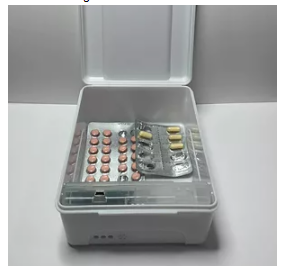
MERM: The Medication Event Reminder Monitor(MERM) is a digital pillbox that provides daily pill-taking reminders and facilitates remote monitoring of medication adherence. This system provides visual and audible reminders for both daily dosing and refill,.transmits this data to a server so that healthcare providers can remotely visualize patients’ dosing histories to support enhanced adherence counselling.
Figure: MERM Box
General stocks and materials
ContentInformation Education and Communication (IEC) Materials
- The purpose of the IEC materials is to create awareness and disseminate information about the disease (signs and symptoms) diagnosis, and treatment to increase accessibility and utilisation of services among the general population.
- IEC material also encourages the build-up of health-seeking behaviour among the masses in keeping with the focus on promotive and preventive health.
- Under IEC, posters, flyers, leaflets, brochures, booklets, etc. are printed and circulated. It is the responsibility of the state to print IEC material in various languages and distribute it among the general population.
- The surplus material is stored at the State Drug Store (SDS) for further distribution as and when required.
Printed Materials
As per the National TB Elimination Programme (NTEP) norms, the districts must use several forms and registers to record the diagnostic and treatment activities. In addition to these, the districts should maintain an adequate supply of printed material for the latest programmatic guidelines. These include the following:
Forms
- NTEP request for examination of biological specimens: Used to request tests such as sputum smear microscopy, Nucleic Acid Amplification Test (NAAT), Line Probe Assay (LPA), culture and Drug Susceptibility Test (DST).
- Treatment card (TB and Drug-resistant TB (DR-TB)): This card contains important information about a patient, such as their name, age, sex and address; type of disease; regimen prescribed; duration of treatment; etc.
- Patient’s identity card (TB and DR-TB patients): The front part of the ID card has patient information, name and address of the TB Unit (TU)/ district and treatment details of the patient including disease classification, type of patient, sputum results, category and information on the date of starting treatment. The back portion of the ID card has the results of the follow-up sputum examination, appointment dates for visits for drug administration and treatment outcome.
- Referral form for treatment (TB and DR-TB): Used when referring patients for treatment to other peripheral health institutions.
- Transfer form: This form is to be used when transferring registered patients on treatment from one reporting unit to another.
- TB notification forms
Registers
- Tuberculosis laboratory register: Used to record the results of sputum smear examinations at the microscopy centres
- Culture and DST laboratory register: Used to record the results of NAAT, LPA, culture and drug sensitivity testing
- Tuberculosis notification register: Contains information on all TB patients registered in the area
- Stock register: Used for recording the information on the stock of drugs and consumables received and issued by the health unit
- Reconstitution register: Used for recording the receipt of drugs of patients who have defaulted, died, failed treatment or transferred out
- Referral for treatment register: Maintained in all big hospitals and medical colleges where large numbers of cases are expected to be diagnosed and referred for treatment to other reporting units
Tablets
NTEP has provided tablet computers to all the key staff with the objective to support the system of capturing important information on a real-time basis. Distribution and storage of these tablet computers is another activity of the drug stores.
Programmatic guidelines
- Technical and Operational Guidelines
- National Guidelines on Programmatic Management of Drug-resistant TB
- National Guidelines on Partnerships
- Desk Reference (Charts on diagnostic algorithm, dosage of anti-TB drugs, any other)
- Laboratory Manual for Sputum Smear Microscopy and NTEP Laboratory Network guidelines for Quality Assurance of smear microscopy for diagnosing TB
- Guidance document on Nutrition Support to TB patients
- Other relevant documents/ guidelines/ circulars circulated by the Central TB Division (CTD).
It is the responsibility of the state to determine once a year the number of forms and registers that would be needed during the following year. The states must ensure that there is an adequate supply of all the forms, registers and guidelines within the state and that sufficient funds are available for the same.
Once printed, all the forms, registers and guidelines are stored at the SDSs from where they are further distributed to the districts and other health units.
Resources
- Technical and Operational Guidelines for Tuberculosis Control, Central TB Division, Ministry of Health and Family Welfare, Government of India, 2005.
- Training Modules (5-9) for Programme Managers & Medical Officers. Central TB Division, Ministry of Health and Family Welfare, Government of India, 2020.
Assessment
Answer 1
Answer 2
Answer 3
Answer 4
Correct answer
Correct explanation
Page id
Part of Pre-test
Part of Post-test
What is the purpose of the referral form for treatment?
Referring patients for treatment to other peripheral health institutions.
Transferring registered patients on treatment from one reporting unit to another.
Both 1 and 2
None of the above
1
The referral form for treatment is used when referring patients for treatment to other peripheral health institutions.
Yes
Yes
Various stocking points in NTEP
ContentUnder the National TB Elimination Programmme (NTEP), there are various stocking points at different levels which help in the storage and distribution of supplies to ensure their uninterrupted availability at all levels.
The various stocking points under NTEP are:
Image
Abbr: GMSD: General Medical Stores Depot; CMSS: Central Medical Services Society; SDS: State Drug Store; DDS: District Drug Store; TU: TB Unit; PHI: Peripheral Health Institute; HF: Health Facility.
Resources
Assessment
Answer 1
Answer 2
Answer 3
Answer 4
Correct answer
Correct explanation
Page id
Part of Pre-test
Part of Post-test
Which stocking point/ points have a reserve stock of drugs for three months?
State Drug Store
District Drug Store
TU Drug Store
Both state and district drug stores
4
As per the standard NTEP norms, both SDS and DDS should have a reserve stock of drugs for three months.
Yes
Yes
Fullscreen