Content Status where content has been uploaded and published on LMS.

Management of DR-TB ADR: Gastrointestinal Symptoms [Gastritis and abdominal pain]

Adverse Drug Reactions (ADRs), such as gastritis and abdominal pain, may occur from the Drug-resistant TB (DR-TB) treatment regimen.

Suspected agent(s): Para Aminosalicylic Acid (PAS), Ethionamide (Eto), Clofazimine (Cfz), Linezolid (Lzd), Fluoroquinolone (FQs), Isoniazid (H), Ethambutol (E), and Pyrazinamide (Z)
Treatment Extension in Isoniazid [H] Mono/Poly DR-TB Regimen

The standard duration of the H Mono/ Poly DR-TB regimen is 6 months.


The treatment duration may be extended in the following conditions:


  • Patients with extensive disease
  • Uncontrolled comorbidity
  • Extra-pulmonary TB
  • Smear at the end of month 4 is found positive
  • When the regimen is modified

Whenever extending treatment, always it is extended directly to 9 months. There is no monthly extension in this regimen.

Eligibility Criteria for Longer Oral M/XDR-TB Regimen

Longer oral Multi (M)/ Extensively-drug Resistant TB (XDR-TB) regimen is recommended for Multi-drug Resistant (MDR)/ Rifampicin-resistant TB (RR-TB) patients who are excluded from shorter oral Bedaquiline-containing MDR/ RR-TB regimen including for the XDR-TB patient. 


A patient would be re-evaluated in any of the following conditions and initiated on a longer oral M/XDR-TB regimen at Nodal (N)/ District DR-TB Centre (DDR-TBC) with any modifications:

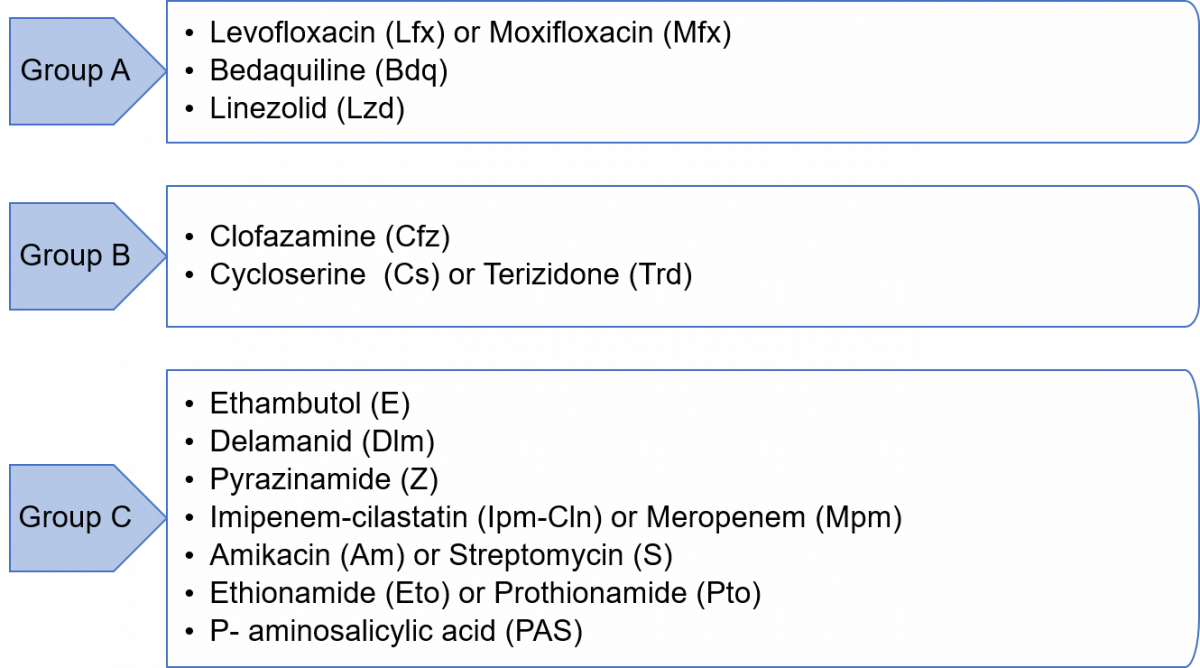
List of Drugs that can be Used Safely or Avoided along with Bedaquiline

Certain drugs can be used safely while others need to be avoided along with Bedaquiline (Bdq). 


The table below provides the list of drugs that should be avoided when Bdq is part of the regimen as well as the drugs that are safe to use with Bdq.


Table: Safe and Contraindicated Drugs with Bedaquiline during Treatment; Source: Guidelines for PMDT, India 2021, p52.

GROUP

SAFE TO USE

DRUGS TO BE AVOIDED

NTEP Budget Heads

The National TB Elimination Programme (NTEP) expenditures are organised under 19 heads. These are:


1. Civil works - Initial establishment/ refurbishment costs and maintenance of civil works costs for Designated Microscopy Centres (DMC), Tuberculosis Units (TU), District TB Centres (DTC), Drug-resistant TB (DR-TB) centres and State Drug Stores (SDS).

ACSM planning based on needs assessment

The preparation of a research and evidence-based Programme Implementation Plan (PIP) is vital for conducting effective Advocacy, Communication and Social Mobilisation (ACSM) activities under the National TB Elimination Programme (NTEP). The plan for ACSM activities should be made based on the needs of the community.

Needs Assessment through Situation Analysis

Situation analysis should start at the TB Unit (TU) level. The Senior Treatment Supervisor (STS) should take the initiative under the guidance and supervision of the District TB Officer (DTO).

Subscribe to Published on LMS