Content Status where content has been uploaded and published on LMS.

Inclusion and Exclusion Criteria for the Use of Bedaquiline

There are certain inclusion and exclusion criteria for the use of Bedaquiline (Bdq) in TB treatment.


Inclusion Criteria

  • Adults and children aged 5 years to less than 18 years of age and weighing at least 15 kg, given their special needs, in consultation with a paediatrician.
  • Patients with controlled stable arrhythmia can be considered after obtaining cardiac consultation.
  • Pregnant & lactating women (with necessary precautions). ​

Exclusion Criteria​

NTEP Services for Private Notified DR-TB Patients

Programmatic Management of Drug-resistant TB (PMDT) services for patients seeking care in the private/ other sectors can be accessed from the National TB Elimination Programme (NTEP) at all levels of the health system. 


  • This includes care offered from the field level, through the network of Health and Wellness Centres (HWCs) under Ayushman Bharat, to tertiary care available in medical colleges/ nodal DR-TB centres and national-level institutions.


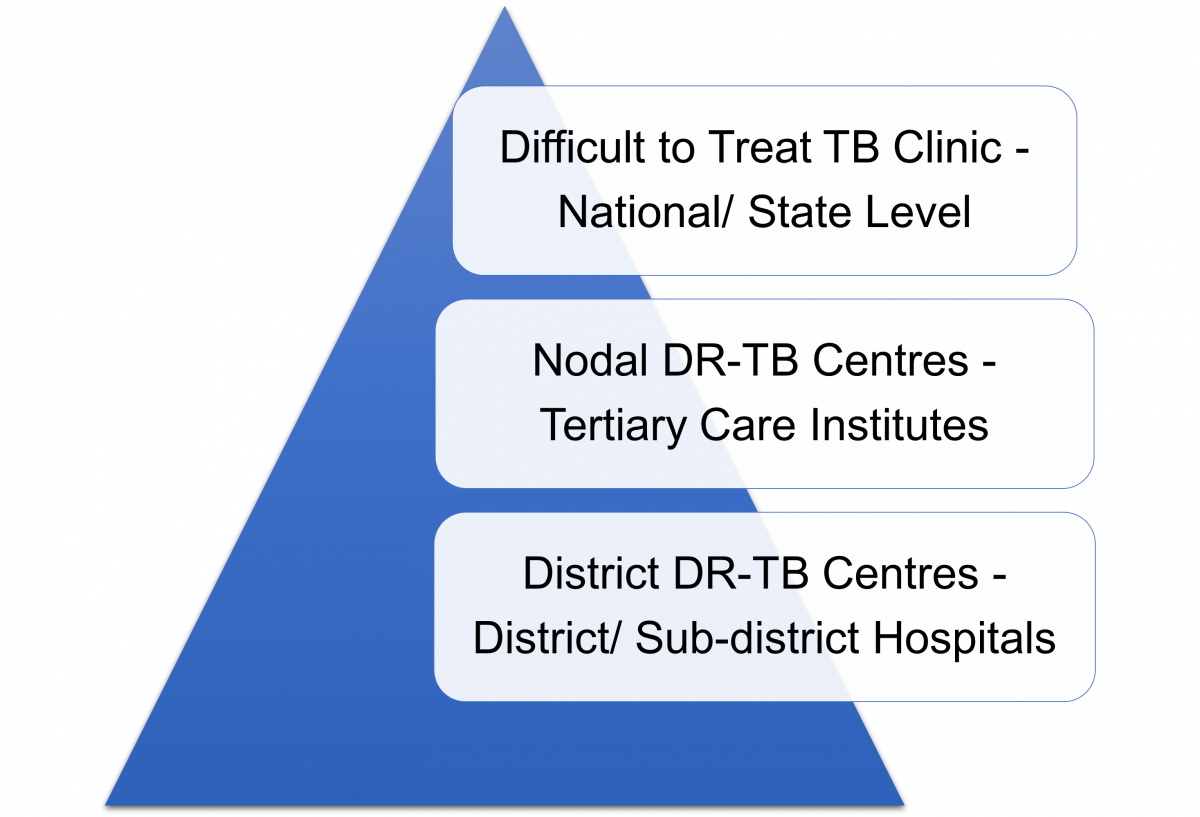
Difficult-to-Treat TB Clinic [DT3C]

The Difficult-to-treat TB clinic (DT3C) is an initiative to support Drug-resistant TB Centres (DR-TBCs) for better patient management. 


The DT3C structure is intended to handhold and mentor District DR-TB centres (DDR-TBCs) for the effective management of Drug-resistant TB (DR-TB) cases.


Figure: Difficult-to-treat TB Clinic: Three-tier Structure

Nodal DR-TB Centre Committee

The Nodal Drug-resistant Tuberculosis Centre (NDR-TBC) committee is a clinical committee that is responsible for taking decisions regarding the management of DR-TB patients at the NDR-TBC.


The composition of the NDR-TBC committee is provided in the table below.


Table: Composition of the NDR-TBC Committee; Source: PMDT Guidelines for India, p205.

Nodal DR-TB Centre

Nodal Drug-resistant Tuberculosis Centres (NDR-TBCs) are established to manage all forms of DR-TB, including complicated cases. ​Therefore, the centre should have:

  • Advanced general laboratory
  • Allied investigation facilities for Pre-treatment Evaluation (PTE)
  • Intensive Care Unit (ICU)
  • Ventilator backup
  • In-house lab/ linkages for PTE laboratory tests


The NDR-TBC is established as per the need and is generally in a tertiary care setting where expertise and facilities for the management of DR-TB are available. ​


Intermediate Reference Laboratories [IRL] and their role

Some Culture and Drug Susceptibility Test (C&DST) laboratories host an Intermediate Reference Laboratory (IRL) under the National TB Elimination Programme (NTEP). 

There is at least one IRL per state at an identified location, usually in a secondary or tertiary level public health facility. There are 34 IRLs in India.

The IRLs are responsible for:

Global TB Treatment Outcomes

  • Globally, an 86% treatment success rate is reported in people treated for TB with first-line regimens in 2019.
  • The figure below showcases the treatment outcomes for new and relapse TB cases as of 2019 (the latest annual patient cohort for which data are available).
  • Data for people who started treatment in 2020, which will become available in 2021, will be needed to assess the impact of disruptions related to the COVID-19 pandemic.

Reliability of a Test for Diagnosis of DR-TB

Reliability is a measure of a test’s performance. The reliability of a diagnostic test depends on theaccuracy and reproducibility of the test results.


In the context of Drug Resistant (DR) TB, the reliable test  should accurately be able to detect the DR-TB and provide important information that assists in the diagnosis, treatment, or monitoring of a patient with DR-TB, i.e., it should provide accurate Drug Susceptibility pattern of TB.


Subscribe to Published on LMS