
Content Status where content has been uploaded and published on LMS.

Management of DR-TB ADR: Alopecia

Alopecia is a rare, minor Adverse Drug Reaction (ADR) that is observed in patients on regimens with Isoniazid (H) and Ethionamide (Eto). It presents with patchy hair loss, mostly from the scalp. It can be easily identified by field-level health care workers and is often reported by patients on their own.
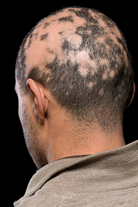
 

Figure: Patchy Hair Loss from Scalp (Alopecia)


Suspected agent(s): Isoniazid (H), Ethionamide (Eto)


Management of DR-TB ADR: Electrolyte Disturbances

Electrolyte disturbances are a rare but serious Adverse Drug Reaction (ADR) that can cause symptoms like irregular heartbeat, fatigue or lethargy, convulsions or seizures, nausea, vomiting and muscle spasms. It requires serum electrolyte lab tests for diagnosis.


This ADR is best managed at the Drug-resistant TB (DR-TB) centre where the patient can be admitted and administered treatment.


Suspected agent(s): Amikacin (Am)


Suggested Management Strategies

Management of DR-TB ADR: Optic Neuritis

In optic neuritis, the patient may present with vision loss, peri-ocular pain and dyschromatopsia (a disorder of colour vision). This is a rare but serious Adverse Drug Reaction (ADR) caused by certain anti-TB medications.


Mild forms of this ADR present with episodes of disturbed or blackened rather than blurry vision, reduced night vision, photophobia and red eyes. Serious cases may present with loss of coloured vision and may also progress to demyelinating optic neuritis.


Management of DR-TB ADR: Hepatitis

Hepatitis is a common adverse drug reaction caused by some Drug-resistance TB (DR-TB) drugs. It is monitored by measuring the Alanine transaminase (ALT) and Aspartate aminotransferase (AST) levels.


If there is jaundice (yellowing of the skin or eyes), field-level health care workers must immediately refer the patient to the nearest higher health centres - District/ Nodal DR-TB Centre/ Sub-district or district hospital, medical college hospitals, etc.


Management of DR-TB ADR: Rash, Allergy and Anaphylaxis Reaction

Hypersensitivity reactions like rashes, allergies and anaphylactic reactions are common Adverse Drug Reactions (ADRs) to any of the second-line anti-TB drugs. 


These ADRs are often reported by patients themselves.


Milder forms of this ADR present with a localised rash that is not associated with mucus membranes. In such cases, patients can be reassured and managed symptomatically at home or at the Peripheral Health Institution (PHI).


Management of DR-TB ADR: QT Prolongation

QT prolongation is a condition in which repolarization of the heart after a heartbeat is affected. 


It results in an increased risk of an irregular heartbeat which can result in shortness of breath or chest pain, fainting, seizures or cardiac arrest. 


If patients experience such signs or symptoms, health workers need to refer such patients to the nearest health facility where Electrocardiogram (ECG) can be done and further management initiated.


Details of Replacement Sequence of Drugs in Longer Oral M/XDR-TB Regimen

Replacement of component(s) drug(s) is required in conditions like adverse drug reaction, poor tolerance, contraindication and resistance detected on baseline Liquid Culture (LC) Drug Susceptibility Testing (DST). 


The replacement sequence of drugs is prepared according to their efficacy, no demonstrable resistance, prior use, side-effect profile and background resistance to replacement drug in the country.

Subscribe to Published on LMS