
Recording and Monitoring Adherence

Recording of Treatment Adherence can be done as

  • Manually by DOT/Health Care Provider in TB Treatment Card of a patient.
  • Self-reported by Patient using digital tools for reporting adherence using 99 DOTS and MERM technologies.


Monitoring Treatment Adherence:

All TB patients should be monitored to assess their response to TB treatment. Nikshay Adherence calendar has a colour legend for various doses taken by a patient
 

Importance of Treatment adherence

Adherence to tuberculosis(TB) treatment is important for promoting individual and public health. Poor adherence to TB treatment results in:

  • More individual suffering and death,
  • Costly treatment as treatment regimens lengthen and
  • Increases the risk for Drug Resistant Tuberculosis


Proper treatment of all forms of TB is critical to reducing individual morbidity and mortality and to interrupting transmission among family and community members.


TB Treatment Adherence

Tuberculosis(TB) is curable if patients are treated with effective, uninterrupted anti-tuberculous treatment. Treatment adherence is critical for curing individual patients, controlling the spread of infection in the community, and minimizing the development of drug resistance.

Adherence to treatment means that a patient follows the recommended course of treatment by taking all the prescribed medications for the entire length of time, as necessary. In other words, “right dose for the right duration”.

Testing for TB Infection

For TB infection, there are two recommended tests which can be used to identify such patients.

Tuberculin Skin Test (TST)

The skin test is done by injecting a small amount (0.5 ml) of TB antigens into the top layer of skin on your inner forearm. If one has ever been exposed to TB bacteria (Mycobacterium tuberculosis), there will be a reaction indicated by the development of a firm red bump (induration) >= 10 mm at the site within 2 days.

DR-TB Treatment Regimens

Depending upon type of drug resistance, there are four broad DRTB Treatment regimen.

  1. H Mono/Poly Treatment Regimen(6-9 months)
  2. Shorter oral Bedaquiline containing MDR/RR-TB regimen(9-11 months)
  3. Shorter injectable containing regimen(9-11 months)
  4. Longer oral M/XDR-TB regimen(18-20 months)


Drugs administered for DRTB Regimen:

DS-TB Treatment – Patient Flow

Community Health Volunteers(CHVs) have to refer the presumptive cases identified based on the r symptom screening to the nearest NTEP health facility for further investigation. Once Diagnosed with TB, the TB patients are initiated on the first-line TB treatment. Patients are also offered NAAT within a maximum of 15 days to rule out any drug resistance. If no drug resistance is detected, then the patient continues on the first-line TB treatment. TB patients are then clinically evaluated every month to check the progress of TB treatment. 

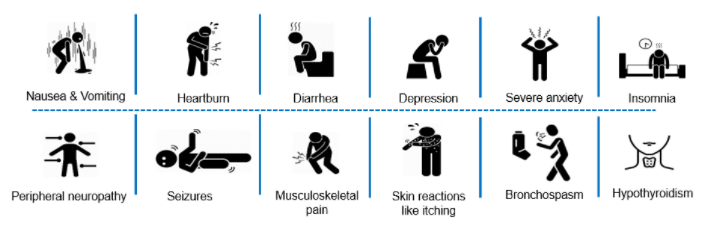
Management of Adverse Drug Reactions(ADRs) of TB Treatment

  1. Counsel and reassure the patient as the common occurring adverse effects usually resolve with time.
  2. Advise the patient to take all the drugs together.
  3. Advise patient to take light meal (biscuits, bread, rice etc.) before taking drugs.
  4. Inform patients that they may take drugs embedded in banana or at the bedtime to reduce their associated side effects.
  5. Encourage patients to keep themselves hydrated by increasing fluid intake.
Subscribe to Sr. DR-TB TB-HIV Supervisor