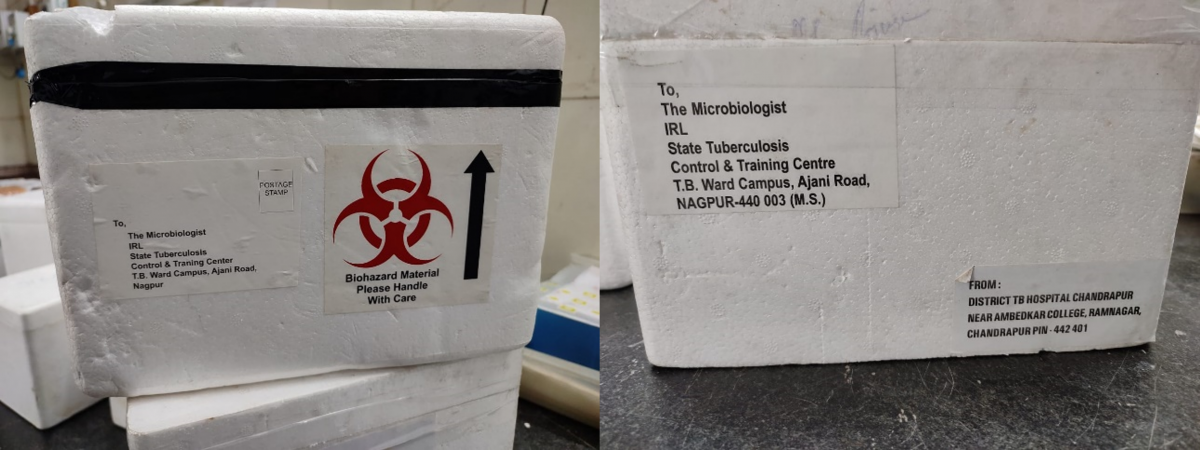
Dispatching the sample to a C&DST Lab

For presumptive Drug-resistant TB (DR-TB) patients’, the health facility staff arranges for specimen collection from patient, packs samples as per the Standard  Operating Procedure (SOP) for triple layer packaging and dispatches it for transportation in cool chain to the linked Culture and Drug Susceptibility Testing (C&DST) laboratory.

All necessary materials for specimen collection and modality for transportation need to be made available/ arranged at the Designated Microscopy Centre (DMC)/ Peripheral Health Institute (PHI) by the District TB Officer (DTO).
 

Truenat

Truenat is an indigenous rapid molecular test platform that is currently under use in NTEP for diagnosis of TB and Rif Resistance. It is a platform utilising real-time Polymerase Chain Reaction (PCR) technology built into micro-PCR chips.

Testing on Truenat involves three components:

Steps involved in Smear Microscopy

Sputum smears must be prepared promptly after samples are collected or received in the laboratory.

Steps in smear preparation are as follows:

  1. Cleaning and Labelling of slide (No 1)
  2. Making the smear (No 2-3)
  3. Drying and Heat fixing the smear (No 4-5)
  4. Staining and counterstaining the smear (No 6- 12)
  5. Examination of slide/Reading the Smear (No 13-14)
  6. Reporting and recording the observations (Digitally and TB Lab register)
  7. Storage of slides (as per Laboratory Numbers in closed box) (No 15)


Qualities of a good sputum smear

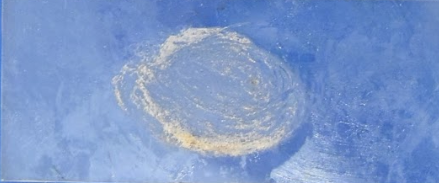
Good quality smears are essential for accurate examination and results. A good quality sputum smear is one that is of uniform thickness and made from the mucopurulent portion of the sample in the center of the slide (Figure 1).


Do’s and Don’ts of a Good Quality Smear

  • Do ensure that the smear size is 3 cm by 2 cm
  • Do ensure there are no fingerprints on the prepared smear


Cleaning and Labelling Slide

A Laboratory Serial Number is assigned to each presumptive TB patient who is examined at the microscopy centre.


Each Laboratory Technician (LT) needs to ensure that all the slides are labelled using the Laboratory Serial Number. This is essential for recording as well as for the review of the slide during the supervisory visit as well as during the quality assurance exercise.


For every test, a new slide needs to be used. It is essential that there are no fingerprints or any scratches on the side of the slide (see figure 1).

Making the smear

The National TB Elimination Programme (NTEP) has a standard procedure for sputum smear preparation, the steps for which are listed below:


The tools required for smear preparation include a clean work surface, new and clean glass slides, a discard bucket or a foot-operated bin with a plastic liner, bamboo or wooden applicator sticks or sterile wire loop, spirit lamp and a rack for drying smears.

Requirements for Packaging a biological Specimen

Peripheral Laboratories in the NTEP need to send biological samples (such as sputum) to nearby Culture and Drug Susceptibility Testing (CDST) laboratories for advanced testing (eg Drug Resistance Testing). The samples need to be safely packaged and transported such that there is no spillage or contamination.

The items required for safe packaging biological specimens are: 

Technical Specifications for Labelling Specimen Transport Carriers

These are the technical specifications for labelling specimen transport carriers:


  • Specimen containers need to be labelled legibly with details such as the patients’ name, date and time of specimen collection, TB detection centre/ District Tuberculosis Centre (DTC), lab no., specimen A or B.

Figure: Details to be filled on the specimen containers


Subscribe to LT-Microscopy