
Community Engagement
ContentCommunity engagement is a process of developing relationships that enable stakeholders to work together to address health-related issues and promote well-being to achieve positive health impact and outcomes.
Mobilize communities to engage them in TB care and to increase ownership of the Programme by communities.
Why Community Engagement?
Figure: Importance of Community Engagement
Importance of Community Engagement in TB
ContentCommunity-based TB activities are conducted outside the premises of formal health facilities (e.g. hospitals and clinics) in community-based structures (e.g. schools and places of worship) and homesteads. Community health workers and community volunteers carry out community-based TB activities. Both can be supported by nongovernmental organizations and/or the government.
Community Engagement is a cost effective intervention to improve health service coverage and deliver accessible and people-centered integrated care.
Figure: Importance of Community Engagement
Strategies of Community Engagement in NTEP
Content- Scaling up community participation in the National TB Elimination Programme through community-led activities and working with various community groups, especially TB survivors and key populations
- Empower TB survivors and affected populations to act as mentor’s/change agents and build their capacity for engaging them in programme planning, implementation and monitoring
- Working with community stakeholders to aid in early case identification amongst the vulnerable population
- Increasing accountability of the service delivery system through community participation
TB Champion
ContentA TB Champion is a person who has been affected by TB and successfully completed the treatment.
TB Champions, in their capacity as survivors, are role models and can provide valuable support to those with TB and their families.
Figure: Roles of TB Champion
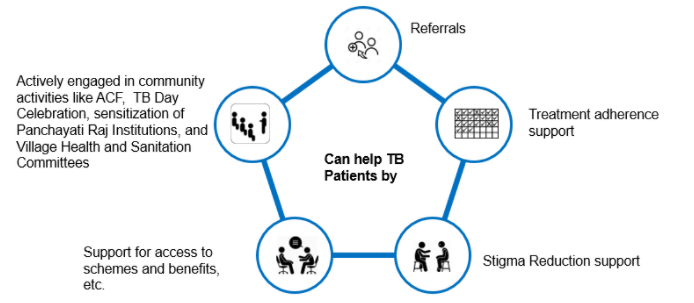
Community Health Volunteers should identify TB Champions and engage them to provide their support to the patient in activities like:
Figure: Help to TB Patients by Community Health Volunteers
Role of Health Volunteers in Community Engagement
ContentInvolve TB Champions: Community Health Volunteers should play a key role in the following aspects
- Identification from TB survivors in the community
- Training in various aspects of TB and role of TB Champions in NTEP activities
- Mentoring and grooming for providing support to TB patients as peer counsellors
- Supporting the formation & functioning of survivor-led networks at various levels
- Recognition and facilitation for good work on occasions like “International TB Day Celebration.”
Engaging community structures at village level: Community Health Volunteers should engage the community for the following:
- Active Case Finding
- TB awareness generation
- Stigma reduction
- Support for TB patients
Psychosocial Support to TB Patients:
- Offer words of encouragement, alleviate anxiety and create awareness.
- Promote kindness, solidarity, compassion; offer to talk to family & community members.
- Connect TB patients to TB community network, TB survivors.
- Have a gender-sensitive approach and ensure gender equality.
- Provide guidance on supportive interventions(e.g., refer to mental health helplines, share information on videos/resources available on MoHFW’s website).
- Choose words carefully while referring to those affected; form treatment support groups.
- Avoid using words like cases, victims, transmitters and suspects.
- Share key messages to prevent stigma; conduct stigma reduction interventions.
Role of Health Volunteers in Community Mobilization
ContentCoordination:
Community Health Volunteers(CHVs) should coordinate with TB Health Visitor(TBHV)/STS/Medical Officer of the health facility/PRI(Panchayati Raj Institutions) regarding regular intake of drugs by the patient.
Home Visits:
CHVs should do Home visits to patients to follow-up and counsel the patient and her/his family for treatment adherence and completion.
Identifying and engaging TB Champion:
Identifying and engaging TB Champions in treatment adherence counselling and other community-based activities.
Community Mobilization:
Community Health Volunteers(CHVs) should mobilize TB patients for their regular health check-up at the nearest NTEP health facility.
Kindly provide your valuable feedback on the page to the link provided HERE
Linkages to Social Support Scheme
Content- Describe the basics on Direct benefit transfer
- Explain the various DBT Scheme in Nikshay with the beneficiary and benefit details
- Describe the criteria for availing DBT scheme benefits
- Explain the role of treatment supporter and their eligible for honorarium
Direct Benefit Transfer(DBT) under NTEP
ContentDirect Benefit Transfer (DBT) is a major initiative of Government of India (GoI) whereby any government subsidy or benefit is to be transferred directly into the beneficiary's bank accounts. Intermediary government agencies only manage the process of payments, without handling actutal money.
NTEP is one of the first health programmes in India to use a fully adopt DBT. It uses an end to end electronic system, to digitise beneficiary information and transfer monetary benefits. In NTEP to process benefits, two electronic systems are used, Ni-kshay (operated by NTEP) and PFMS (Public Finance Management System, operated by the Ministry of Finance). Ni-kshay enables Direct Benefit Transfer by digitizing the beneficiaries(bank account details of patients, treatment supporters and providers) and calculates of incentives/ benefits (eligible payment) and processes them for payment through PFMS under various schemes. The various schemes operational under NTEP are:
- Nikshay Poshan Yojana(NPY)
- Tribal Support Scheme
- Treatment supporter’s Honorarium
- Incentive for Notification and Outcome
DBT Schemes in Nikshay
Other Local DBT Schemes
ContentThere may be other Central or State government schemes and programmes that beneficiaries related to the TB program are eligible for, over and above the 4 schemes provided by the central government through NTEP. Some examples are:
- State Illness Relief Fund (can serve seriously ill TB patients)
- Chief Minister’s Farmers Security Scheme
- Nutritional Support to DR-TB Patients
- Sanjay Gandhi Niradhar Yojana
- Surakhaya Yojana
- Pridhar Parasar Yojana
- Scheme for treatment of critical disease for schedule caste/schedule Tribe and people below poverty line (BPL).
- Rastriya Swasthiya Bhima Yogana (RSBY) reimbursement for those TB patients who required hospitalisation
- Sudurvarti Sahayaks from CM's Sudurvarti Gram Yojana involved TB services
These schemes are paid through their respective payment processing channels and not through Ni-kshay.
Criteria for availing DBT Scheme benefits under NPY
Content- All TB patients notified on or continues treatment after 1st April 2018 including all existing TB patients under treatment are eligible to receive incentives.
- For availing DBT scheme benefits under NTEP Programme, TB patients have to provide their bank details to the nearest NTEP Health facility.
- The patient must be registered\notified on the NIKSHAY portal.
- Each beneficiary can be linked to unique savings bank account belonging to him/her. Beneficiaries without bank accounts need to be facilitated to open bank accounts in any bank as convenient.
- If a Beneficiary does not have a bank account and is unable to open a new bank account, his/her relative’s bank account may be used(immediate family member such as parents, spouse, siblings).
- If a relative’s bank account is used, written consent should be taken from beneficiary.
- If a bank account has already been used for another beneficiary, it cannot be re-used for another beneficiary. If a new Bank account needs to be opened, it’s easy to open a zero-balance account with Indian Post Payments Bank.
Fullscreen