
-
Ch 07: Public Health Action
FullscreenPublic Health Actions
ContentPublic Health Action is conducted under the NTEP programme to support and prevent further health complications among TB patients after diagnosis.
Figure: Various activities under Public Health Action
Contact Tracing and Investigation
ContentContact tracing is a process to identify people who are at a high risk of developing TB due to their contact with a known TB case.
The aim of contact tracing is to find other people with TB disease and those infected with TB
All close contacts, especially household contacts of a Pulmonary TB patient, should be screened for TB.
In paediatric TB patients, reverse contact tracing for the search of any active TB case in the child's household must be undertaken.
Particular attention should be paid to contacts with the highest susceptibility to TB infection.
Figure: Contacts to be Prioritized for contact TB screening
Home visit to TB Patients
ContentInteraction with the patients and their families is crucial to gauge a patient's understanding of the disease he/she is suffering from and the course of treatment to be followed.
Aspects to be considered during a Home visit:
- First home visit should be completed within 7 days of the patient's diagnosis.
- Patients who have Adverse Drug Reaction(i.e. ADR) / interrupted treatment /Loss to follow up /Repeat episode, interrupted the treatment should be given preference and would be preferable if the In-charge of the health facility accompany the team during home visit.
Figure: Precautionary measures to be advised to patient during home visit
Treatment supporter to TB Patient
ContentA Treatment Supporter can be any person such as a Medical Officer, MPWs, community volunteers working with the program etc. Even a patient’s relative or family member can be a Treatment Supporter.
As per NTEP guidelines, salaried NTEP/General Health System staff may also be assigned as treatment supporters for a patient. However, they will not be eligible for any honorarium.
A patient can only be linked to one treatment supporter at a time in Nikshay.
Task performed by Health Volunteers on Home Visit to TB Patient
Content- Screening for four symptom complex for TB and refer for testing
- Support for treatment adherence
- By self-monitoring
- Patient /family counselling
- Peer group support meetings
- Counselling of TB Patients
- To report Adverse Drug Reaction(ADR), if any
- Adhere to the treatment and ensure treatment completion
- Regular monthly follows up during treatment
- Nutritional support
- Supporting the patients in getting linked with existing nutritional supplementation schemes
- Socio economic support
- Profiling of patients to determine eligibility for the scheme
- Support to file application for socio-economic schemes
- Collaboration with non-governmental sources
- Community engagement
- Promotion of other Health programmes.
-
STS: TB Arogya Sathi App
FullscreenTB Aarogya Sathi
ContentTB Aarogya Sathi empowers Citizens(including TB Patients under NTEP) and to serve as a Direct interface with the healthcare system. The App is aimed at augmenting the initiatives of the Central TB Division, Government of India in proactively increasing awareness among the citizens and ensuring availability of free and quality assured drugs and diagnostics to all citizens in the country.
Citizens using the TB Aarogya Sathi App will have access to common FAQs regarding TB, Information on the symptoms of TB and Side effects of Anti TB drugs. Using the app, any user will be able to find the closest health facilities that can assist in diagnosis of TB.
Patients registered with Nikshay will have access to the Adherence, Treatment Progress and DBT Details.
Citizen:
- Informative Content available for all Citizens using the App(no login required to access this content)
- Information on TB
- Symptoms of TB
- Side Effects of TB
- Health Facility Search
- BMI Assessment
- Nikshay Sampark Helpline
- Motivational Videos
- Nutritional Advice
Patient:
- Patients registered in Nikshay get access to additional information(after login)
- Adherence Details
- Treatment Progress Details
- DBT Details
TB Aarogya Sathi App is available in Google play store and can be download using this QR Code
Figure: TB Aarogya Sathi Application snapshot
- Informative Content available for all Citizens using the App(no login required to access this content)
Download the Tb Arogya Sathi App and Steps to Login
ContentVideo fileVideo: Download the Tb Arogya Sathi App and Steps to Login
Health Facilities
ContentVideo fileVideo: Health Facilities
Summary and Treatment Progress View
ContentVideo fileVideo: Summary and Treatment Progress View
View Adherence Details
ContentVideo fileVideo: Adherence Details and DBT Details View
View DBT Details
ContentVideo fileVideo: DBT Details View
Adding bank details in the Arogya Sathi App
ContentVideo fileVideo: Adding bank details in the Arogya Sath App
Symptom Checker-Overview
ContentVideo fileVideo: Symptom Checker-Overview
Screening for Self and Others
ContentVideo fileVideo: Screening for Self and Others
Post enrolment follow-up cycle in Nikshay
ContentVideo fileVideo: Post enrolment follow-up cycle in Nikshay
-
Ch 08: Counselling
FullscreenTB Awareness Generation in Community
ContentAwareness should be generated in the community for promoting various health programmes, health seeking behaviours, screening of TB cases etc. by involving and sensitizing community influencers including PRI members and treatment support groups.
Figure: Activities for awareness generation in community
Counselling of TB Patients
ContentConfidential dialogue between a health care provider and a patient that helps a patient to define his/her feelings, cope with stress, and to make informed decisions regarding treatment.
The patient should be counselled at all the three phases i.e.,
Pre-treatment counselling`
- About TB disease and treatment
- Air borne infection control
- Need for adherence
- Public Health Actions
- Identification of adverse events
- Tobacco /Alcohol cessations
- Identification of comorbidities
During Treatment Counselling
- Importance of Adherence
- Identification of adverse events
- Importance of timely follow ups
- Public Health Actions
- Tobacco /Alcohol cessations
- Management of comorbidities
Post treatment Counselling
- Testing at the end of treatment.
- Long term follow up
- Tobacco /Alcohol cessations
Objectives of TB Counselling:
- Prevention of TB transmission.
- Provision of emotional support to TB patients.
- Motivation of TB clients to complete treatment.
- Helping patients make their own informed decisions about their behaviour and supporting them in carrying out their decisions.
Figure: Characteristics of effective counselling
Do's & Don'ts for Patient Communication
ContentDo’s
- Active listening, emphatic gestures and expressions
- Ensure the confidentiality of the conversation done with the patient
- Ensure Minimum interruption during the conversation with patient
- Ensuring availability of IEC materials such as posters, videos, pamphlets etc. to dispel myths and misconceptions.
Don'ts
- Do not use any negative stereotypes
- Do not have any physical wall or glass between patient and yourself
- Do not breach the trust and confidentiality of the TB patient
- Do not make threats or use coercive language
- Do not exaggerate dangers or risk of TB
- Do not blame or shame TB patients
Nutritional Counselling for TB Patients
ContentNutritional Counselling begins with the nutritional assessment of TB patients by
- Nutritional Status: Assessing the height, weight and BMI of the TB patient
- Diet and Preference food for TB patients
- Current appetite and food intake of TB patients
Based on the nutritional assessment, the following information can be conveyed to TB Patients
- Patients with TB should be encouraged to have frequent food intake in the form of three meals and three snacks.
- Attempts should be made to increase the energy and protein content in the meals and snacks without increasing its volume.
- The addition of oil, butter or ghee to the chapati or rice can increase the energy content of the diet.
- Pulses in other forms, e.g. sprouts, roasted Chana, groundnuts, can be taken as snacks in either fried or in roasted form. Milk and eggs to be included in the diet.
- The use of easily available nutritious foods based on vegetarian/non-vegetarian preferences of the patients must be emphasized.
- Information about NFSA(National Food Security Act) and Poshan abhiyan should be given.
Figure: Healthy diet for TB Patients
-
Ch 09: Social Inclusion and Wellness Activity
FullscreenStigma and Discrimination towards TB Patient
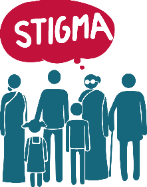
ContentStigma is when someone sees you in a negative way.
Discrimination is when someone treats you in a negative way.
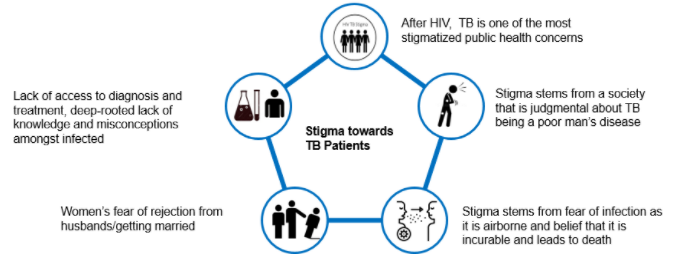
TB patients face various forms of stigma and discrimination in the community
Figure: Stigma towards TB Patients in the community
Effects of Stigma on TB Patients
ContentAt Individual Level
- Lack of self-esteem and confidence
- Increased sense of emotional isolation, feeling of guilt and anxiety
- Physical as well as financial debilitation
- People, more often women, are forced to leave their homes
- Concealing symptoms and hesitancy in seeking medical care making disease management more difficult
- Delayed diagnosis, interrupted treatment that can lead to further transmission and DRTB
- Vulnerability increases, can lead to suicidal thoughts due to isolation and shame
At Family and Community Levels
- Loss of household earnings
- Exposure of caregivers to the risk of infection that lowers productivity and cycle of poverty further gets perpetuated
- Isolation and stigmatization of infected persons often by people of their community
- Deep-rooted lack of knowledge and misconceptions among the affected and infected within their cultural and religious environment
- Loss of status and negative impact on those with the disease, their caregivers, family, friends and communities
- Perceived and internalized stigma of the community due to socio-cultural values that TB is punishment for sins or transgression
Treatment Supporter Honorarium Eligibility
ContentTreatment supporters are eligible for Honorarium at the end of TB patients treatment, only if the patient's treatment outcome has been declared either as "Cured “or "Treatment Complete".
The eligible amount of honorarium is
- Rs. 1,000 for DSTB Patients and for
- Rs. 5,000 for DRTB patients.
These benefit amount are processed through Nikshay and below are the prerequisite conditions that needs to be met in Nikshay, for generating incentive
- Treatment supporter should be registered and enabled for receiving honorarium from Nikshay.
- Bank details of Treatment supporter should be submitted to the nearest NTEP health facility staff.
- In Nikshay, this is the only scheme where benefits are generated manually by TU users - STS
- Nikshay will allow NTEP TU users to generate benefits, only if
- Treatment Outcome has been declared as "Cured “or "Treatment Complete"
- Patient duplication status should be Unique i.e. Nikshay marks the patient duplicate based on Gender and Mobile Number
- For DSTB patient, one benefit of maximum amount of Rs. 1,000 can be created if outcome is updated as “Cured” or “Treatment Completed
- For DR TB patients two benefits can be generated in Nikshay:
- First benefit of maximum amount Rs. 2,000 can be created at end IP - Intensive Phase (i.e. Initiation Date + 6 months)
- Second benefit of maximum amount Rs. 3,000 can be created if Outcome is updated as “Cured” or “Treatment Completed”
-
CH 10: Community Engagement
FullscreenCommunity Engagement
ContentCommunity engagement is a process of developing relationships that enable stakeholders to work together to address health-related issues and promote well-being to achieve positive health impact and outcomes.
Mobilize communities to engage them in TB care and to increase ownership of the Programme by communities.
Why Community Engagement?
Figure: Importance of Community Engagement
Importance of Community Engagement in TB
ContentCommunity-based TB activities are conducted outside the premises of formal health facilities (e.g. hospitals and clinics) in community-based structures (e.g. schools and places of worship) and homesteads. Community health workers and community volunteers carry out community-based TB activities. Both can be supported by nongovernmental organizations and/or the government.
Community Engagement is a cost effective intervention to improve health service coverage and deliver accessible and people-centered integrated care.
Figure: Importance of Community Engagement
TB Champion
ContentA TB Champion is a person who has been affected by TB and successfully completed the treatment.
TB Champions, in their capacity as survivors, are role models and can provide valuable support to those with TB and their families.
Figure: Roles of TB Champion
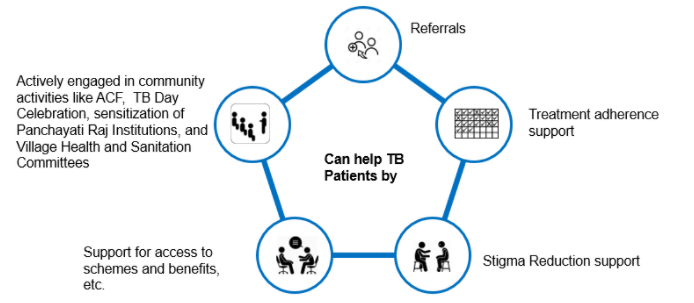
Community Health Volunteers should identify TB Champions and engage them to provide their support to the patient in activities like:
Figure: Help to TB Patients by Community Health Volunteers
Role of Health Volunteers in Community Engagement
ContentInvolve TB Champions: Community Health Volunteers should play a key role in the following aspects
- Identification from TB survivors in the community
- Training in various aspects of TB and role of TB Champions in NTEP activities
- Mentoring and grooming for providing support to TB patients as peer counsellors
- Supporting the formation & functioning of survivor-led networks at various levels
- Recognition and facilitation for good work on occasions like “International TB Day Celebration.”
Engaging community structures at village level: Community Health Volunteers should engage the community for the following:
- Active Case Finding
- TB awareness generation
- Stigma reduction
- Support for TB patients
Psychosocial Support to TB Patients:
- Offer words of encouragement, alleviate anxiety and create awareness.
- Promote kindness, solidarity, compassion; offer to talk to family & community members.
- Connect TB patients to TB community network, TB survivors.
- Have a gender-sensitive approach and ensure gender equality.
- Provide guidance on supportive interventions(e.g., refer to mental health helplines, share information on videos/resources available on MoHFW’s website).
- Choose words carefully while referring to those affected; form treatment support groups.
- Avoid using words like cases, victims, transmitters and suspects.
- Share key messages to prevent stigma; conduct stigma reduction interventions.
-
Ch 11: Linkages to Social Support Schemes
FullscreenDirect Benefit Transfer(DBT) under NTEP
ContentDirect Benefit Transfer (DBT) is a major initiative of Government of India (GoI) whereby any government subsidy or benefit is to be transferred directly into the beneficiary's bank accounts. Intermediary government agencies only manage the process of payments, without handling actutal money.
NTEP is one of the first health programmes in India to use a fully adopt DBT. It uses an end to end electronic system, to digitise beneficiary information and transfer monetary benefits. In NTEP to process benefits, two electronic systems are used, Ni-kshay (operated by NTEP) and PFMS (Public Finance Management System, operated by the Ministry of Finance). Ni-kshay enables Direct Benefit Transfer by digitizing the beneficiaries(bank account details of patients, treatment supporters and providers) and calculates of incentives/ benefits (eligible payment) and processes them for payment through PFMS under various schemes. The various schemes operational under NTEP are:
- Nikshay Poshan Yojana(NPY)
- Tribal Support Scheme
- Treatment supporter’s Honorarium
- Incentive for Notification and Outcome
DBT Schemes in NTEP
ContentSchemes Beneficiary Benefit Amount Nikshay Poshan Yojana(NPY) - All Notified TB Patients in Nikshay from the point of diagnosis
Rs. 1000 at the time of Notification and Rs 500 per treatment month there after paid in advance as installments. Tribal Support Scheme Confirmed TB Patients residing in Tribal TU Rs 750(one time) at the time of notification Treatment supporter’s Honorarium Treatment supporters of patients who have achieved outcome of treatment success - Rs 1,000 in the case of DS TB patients and Rs 5,000 in the case of patients, paid at the time of treatment completion.
Incentive for informants, Notification and Outcomes Private Health Facilities: including Practitioner /Clinic etc.(Single), Hospital/Clinic/Nursing Home etc.(Multi), Laboratories and Chemists
Any citizen reporting TB patients to public health facility or a self-reporting by patient may also be incentivized as an informant
- Rs 500 for Notification or informant
- Rs. 500 for Outcome declaration to health facilities.
Criteria for availing DBT Scheme benefits under NPY
Content- All TB patients notified on or continues treatment after 1st April 2018 including all existing TB patients under treatment are eligible to receive incentives.
- For availing DBT scheme benefits under NTEP Programme, TB patients have to provide their bank details to the nearest NTEP Health facility.
- The patient must be registered\notified on the NIKSHAY portal.
- Each beneficiary can be linked to unique savings bank account belonging to him/her. Beneficiaries without bank accounts need to be facilitated to open bank accounts in any bank as convenient.
- If a Beneficiary does not have a bank account and is unable to open a new bank account, his/her relative’s bank account may be used(immediate family member such as parents, spouse, siblings).
- If a relative’s bank account is used, written consent should be taken from beneficiary.
- If a bank account has already been used for another beneficiary, it cannot be re-used for another beneficiary. If a new Bank account needs to be opened, it’s easy to open a zero-balance account with Indian Post Payments Bank.
Fullscreen